
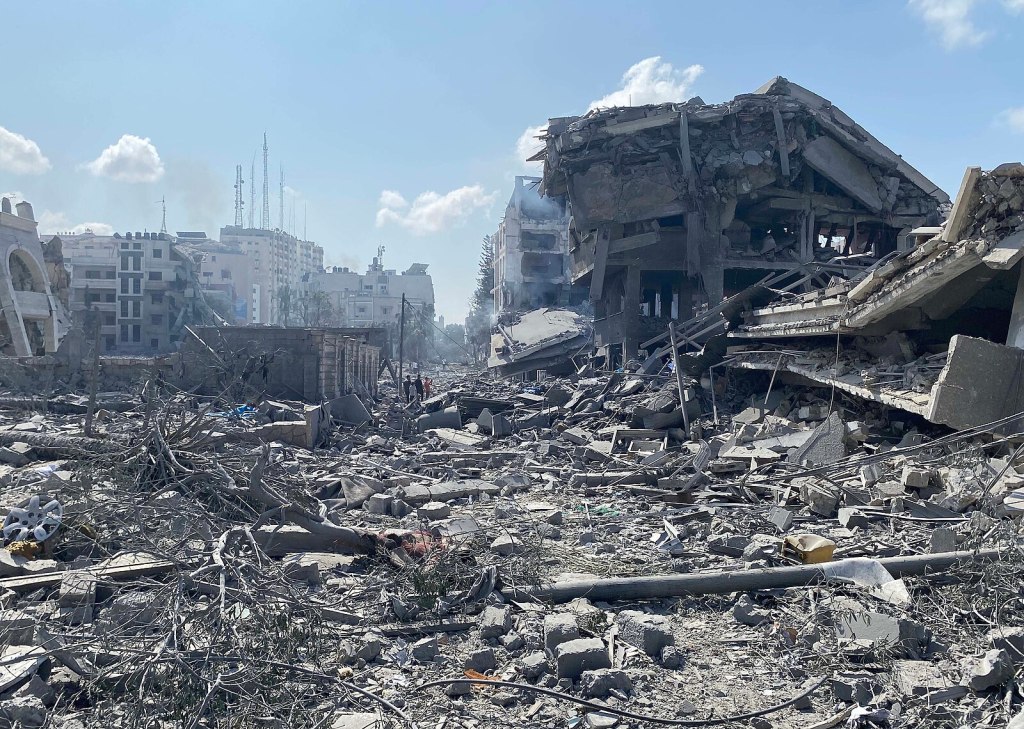
On February 4th, President Trump declared that the United States would “take over the Gaza strip,” and “own it.” The announcement, made at a White House press conference alongside Israeli Prime Minister Benjamin Netanyahu, sparked global shock and condemnation. Southeast Asian countries, several of which have sizable Muslim demographics, have expressed vocal opposition.
President Trump on Tuesday, February 4th declared that the United States would “take over the Gaza strip,” and “own it.” The announcement, made at a White House press conference alongside Israeli Prime Minister Benjamin Netanyahu, sparked global shock and condemnation.
The 2.1 million inhabitants of Gaza would have “no alternative” but to be displaced into countries in the region such as Egypt and Jordan. Trump has stated that the US would build up six new sites for Palestinian to live outside of Gaza, while Gaza would be developed into the “Riviera of the Middle East.” Trump’s Gaza plan won’t happen. Rivals and allies alike—with the exception of Israel, of course—reject it.
The announcement will, however, carry consequences. It could embolden ultranationalist Zionist sentiment and weaken vital efforts at diplomacy and reconciliation. Notably, it could derail Saudi-Israeli ties that have seen prospects of a normalization agreement in recent years. Hamas announced on Monday that it would suspend the next release of captives indefinitely, accusing Israel for violating terms of the ceasefire.
Southeast Asian countries, several of which have sizable Muslim demographics, have expressed vocal opposition. Malaysia has said it “strongly opposes” the forced displacement of Palestinians and that it would constitute “ethnic cleansing.” Malaysia, a Muslim-majority country that has yet to establish diplomatic relations with Israel, has been among the staunchest in opposing the plan.
Indonesia’s Foreign Ministry has stressed the importance of international law and the right to self-determination for Palestinians, but said it would not take an “emotional” or “reactionary approach” to Trump’s antics, instead adopting a wait-and-see position on the situation. Singapore’s Foreign Ministry spokesperson said that Minister of Foreign Affairs Dr Vivian Balakrishan had also reiterated the country’s long standing support for Palestinians’ and the importance of negotiating a two-state solution.
US adversaries Russia and China have rebuked Trump’s plans. China’s vice-minister for foreign affairs Chen Xiaodong told a group of ambassadors from Arab states on Friday that “Gaza belongs to Palestinians and is an inseparable part of Palestinian territory.”
China’s counter-rhetoric to Trump may help improve Beijing’s diplomatic posture in Southeast Asia. The region’s growing economic and strategic importance places it at an increasingly important position in the wider US-China competition, and both superpowers will be keen to advance their interests, especially with regards to trade, investment and security, in the area.
A survey by the Singapore-based think tank, the ISEAS–Yusof Ishak Institute, found that from 2023 to 2024, both Malaysia and Indonesia saw a large spike in the percentage of respondents who believe ASEAN should align itself with China instead of the US. 75% of Malaysian respondents believed ASEAN should align with China over the US in 2024 compared to 55% in 2023. In Indonesia, the figures are 73% and 54%, respectively.
This spike coincides with the US’ support for Israel through arms sales during the Gaza-Israel conflict since October 7th, 2023. Strong Muslim demographics in such countries can exert strong sway on public opinion in such contexts.
Such developments underscore the importance for countries—especially the US and China—to carefully consider their rhetoric on sensitive issues in their conduct of diplomacy. The repercussions of Trump’s comments remain to be seen.
Image credits: Wikimedia Commons
 Sino-Southeast Initiative