
The past failures of SEATO highlight the challenges of forming regional alliances in Southeast Asia and demonstrate that economic cooperation are more viable than security partnerships like NATO.
With a Trump 2.0 administration increasingly focusing on China and Southeast Asia in 2025, a look at the regional alliance structure of the present might warrant a look at the past. As China looks to reaffirm its regional stronghold and America seeks to re-enter Southeast Asia, the US’ mistakes of the past may prove a guide for any new regional security establishments that may develop today.
June 30th, 1977, Bangkok, Thailand. After 23 years of operations, the Southeast Asia Treaty Organization, or SEATO, was formally dissolved, having been dogged with criticism throughout the nearly two decades since its founding. What was this NATO counterpart in the Indo-Pacific, why did it fail, and could it be revived today?
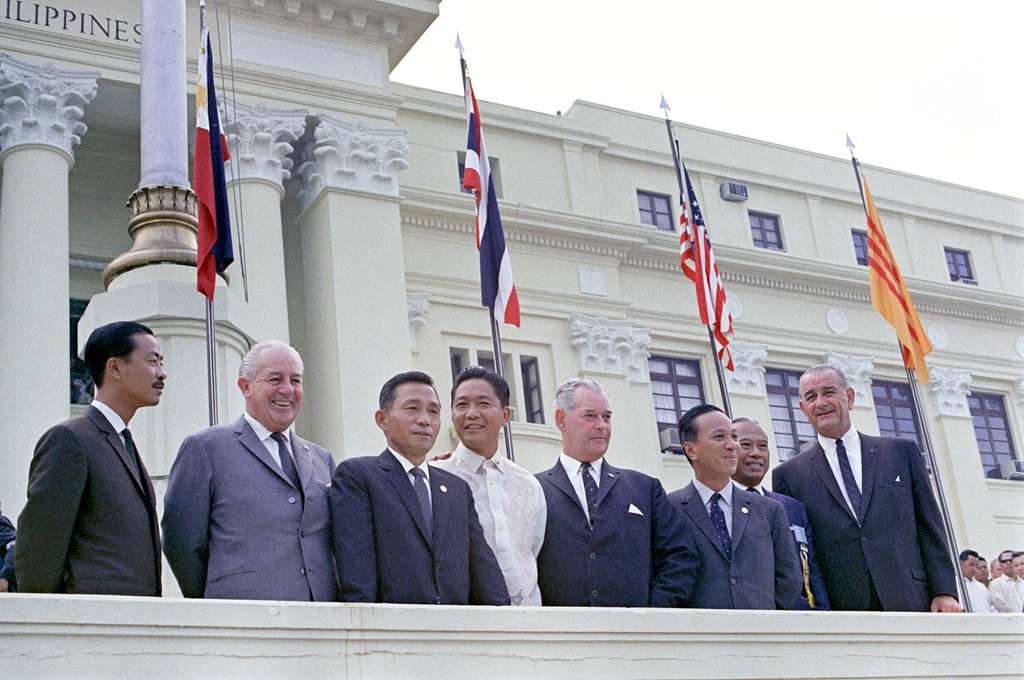
The basics: SEATO was founded on September 8th, 1954, as an initiative spearheaded by President Eisenhower’s Secretary of State John Forster Dulles and then-Vice President Richard Nixon in the context of the Southeast Asia Collective Defence Treaty, also known as the Manila Treaty. Modelled after NATO, the organization consisted of a Secretariat and a non-American Secretary General from another member state, as well as key commissions on political, economic, social, and military affairs. Its aim was, like NATO, to protect Southeast Asia from communism, acting as a bulwark to contain growing Chinese influence in the region.
Despite its potential, the organization was set up for failure from its inception. In contrast to NATO, SEATO did not have an integrated military command structure, and a very vague response protocol to threats presented by communism. Especially notable was the lack of a formal strategy of how the organization should respond to military encroachment – there existed no equivalent to NATO’s famed Article 5.
The true weakness of the organization, however, lay in its membership. SEATO counted eight members: the United States, United Kingdom, France, Australia, Pakistan, the Philippines, Thailand, and New Zealand. What makes this list curious is the fact that the Philippines and Thailand are the only members of SEATO who are actually based in Southeast Asia. The other nations were members due to their colonial or quasi-colonial holdings (French Indochina for France, Papua New Guinea for Australia, East Pakistan (modern-day Bangladesh) for Pakistan, Hong Kong and Borneo for the UK) or simply due to their global power (US) or alliance structure (New Zealand). Having most members of SEATO based outside of Southeast Asia is one of the most important reasons for SEATO’s failure, as the organization was widely perceived to be a tool for the United States and its allies to intervene in the Indo-Pacific region.
So, what about its achievements? SEATO, whilst having a very weak military component, did provide a rationale for US involvement in Vietnam: being a member of SEATO and an opponent of communism were significant ‘legal’ reasons justifying US involvement in the conflict, despite the non-membership of then-independent Vietnam. The main successes of SEATO can instead be found in its initiatives regarding questions of education, research, and cultural exchange. SEATO sponsored the creation of the SEATO Graduate School of Engineering, which has outlasted its parent organization and became the Asian Institute of Technology. SEATO also established the International Center for Diarrhoeal Disease Research in Dhaka, which would become the world’s leading research facility for Cholera.
As a security organization, however, SEATO was a failure. It was ineffective as a deterrent, and with the rise of independence movements opposed to Western colonialism, an organization dominated by Western powers was clearly going to have little success engaging in the Indo-Pacific region. Quoting historian and diplomat Sir James Cable, the Manila Pact and SEATO were classic examples of “paper tigers”; SEATO was an organization that looked scary and powerful, but was, in fact, utterly useless in the broader sense of things: it lacked regional acceptance, did not have a strong defence structure, and would become heavily tainted by the Vietnam war. Therefore, as East Pakistan became Bangladesh, Pakistan withdrew from the organization in 1971, and after South Vietnam’s defeat in the Vietnam war, France withdrew in 1975, leading to SEATO’s ultimate dissolution under President Carter.
The key lesson to be learned from SEATO is that Southeast Asia and the North Atlantic region are two very different geopolitical systems and with different needs. NATO was founded on the singular common threat of the USSR in a period where there was a true “us or them” mentality. Such a mentality never existed in Southeast Asia, and nations in the region remain wary about picking sides. Neither China nor the US are members of ASEAN and, according to recent surveys of academic, government, and business leaders of ASEAN member states, many wish for the region to stay neutral and out of great power politics. Regional players are more likely to focus on economic prosperity and development, rather than security and defence.
Therefore, a revival of SEATO or any other Western-led defensive organization in Southeast Asia, remains very unlikely. Despite some American and other officials seeing a NATO-like alliance as the right path for Southeast Asia to protect it from increased Chinese influence, finding a set of countries willing to risk Beijing’s wrath and join an organization that would so clearly threaten China’s role in the region, would be unlikely and only escalate the current political climate.
To best cater to the area and create a system of security, bilateral security agreements strengthened through trade and economic measures is the best way forward. A military alliance so clearly skewed towards the interests of external actors is not a fit for Southeast Asia. The revival of SEATO, while tempting on paper, is unlikely to emerge anytime soon.
Whilst the world of 2025 is very different to that of 1977, questions surrounding regional security remain at the forefront of the regional geopolitical arena. As the region will become a geopolitical hotspot, while SEATO is a thing of the past, the emergence of a regional security alliance – whether backed by either China or the US, or as a new independent regional alliance – may not be too far off. And whilst ASEAN may be the natural steppingstone to this, already focusing on the idea of “cooperative security,” a look in the past might just be a guide for the present.
Image credits: Wikimedia Commons
A version of this article was first published in partnership with the NATO Association of Canada.
Paul Meyer
Paul is a foreign policy and international trade professional, currently working as Director – U.S. Trade Policy for the German Chamber of Industry and Commerce in Berlin on issues of bilateral trade and national and European economic policy. Having lived in China for over eleven years, affairs in the region have always been of close professional interest. Paul graduated from the University of Toronto with a Hons. BA in Public Policy, International Relations and Economics in 2024.
 Sino-Southeast Initiative