
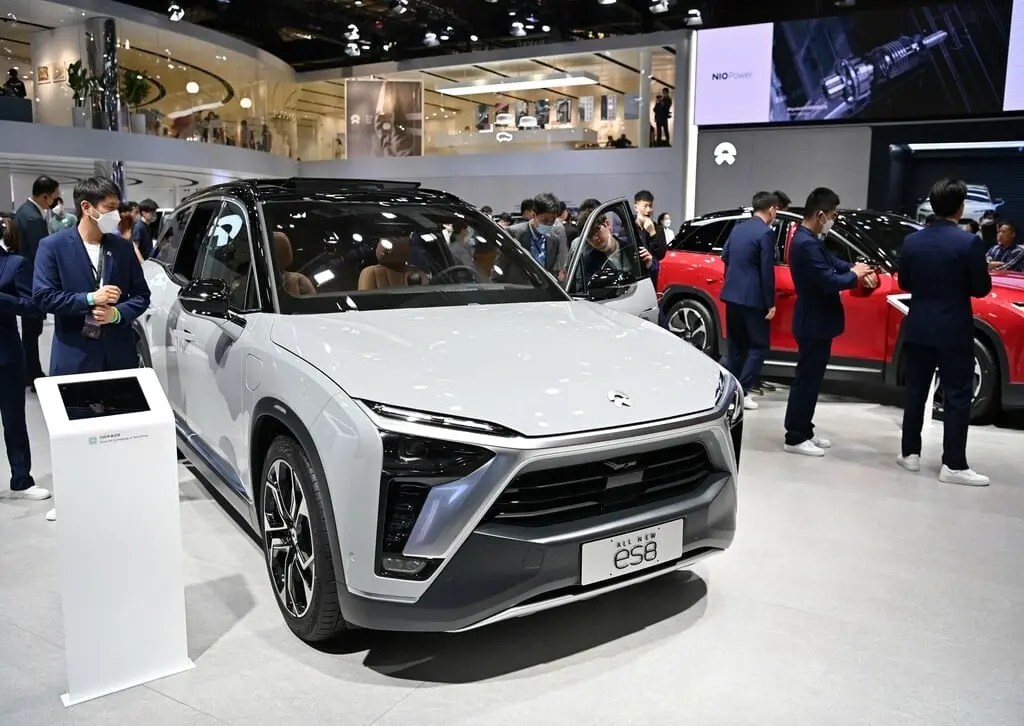
In the rapidly evolving landscape of global automotive manufacturing, China’s electric vehicle (EV) sector has emerged as a testament to the power of specialized industrial organization. While traditional automakers in Germany and Japan struggle with declining market share, Chinese EV manufacturers have achieved remarkable success through a model of focused specialization across the supply chain. From CATL’s dominance in battery production to NIO’s leadership in software integration, Chinese firms have demonstrated that success in the EV era requires deep expertise in either manufacturing or technology innovation and integration, but rarely both. This transformation, enabled by China’s comprehensive industrial ecosystem and accelerated by supportive policies, offers crucial lessons about how specialization and scale drive innovation in modern manufacturing.
In the span of a few years, China’s EV sector has emerged to become a world leader in the automotive industry. While much debate and controversy circles around the role of the Chinese government in aiding the development of its EV sector, few can deny the tremendous innovation the industry has seen and its rippling impact across economies across the globe. Volkswagen is experiencing rapidly declining sales in China and has already taken action to shut down its Audi factory in Belgium. In Japan, Nissan teeters on the brink of survival as talks of mergers and acquisitions with Honda and Mitsubishi loom. As the transition to EVs accelerates, traditional automakers will inevitably face increased competition.What drove the emergence of China’s EV sector to be so successful? Based on my recent trip to China and conversations with various stakeholders in the industry, I believe it is fundamentally a matter of economics founded on the principles of specialization. The key challenge, however, is having the ability to rapidly respond to consumer needs in order to identify the most valuable areas for specialization.
The principle of specialization can be traced back to Adam Smith, who stated that “the greatest improvement in the productive powers of labor, and the greater part of the skill, dexterity, and judgment with which it is anywhere directed, or applied, seem to have been the effects of the division of labor.” In his renowned pin factory illustration, Smith demonstrated that when ten workers were each assigned specific tasks from a set of eighteen specialized operations, they could collectively produce 48,000 pins daily, resulting in an average productivity of 4,800 pins per worker per day. In stark contrast, without such division of labor, an individual worker might struggle to create even a single pin in a day.
China’s economic growth is significantly bolstered by its unique combination of scale, diversity, and completeness in its supply chains. This comprehensive ecosystem, encompassing high-skilled to low-skilled labor, vast consumer markets, and a wide range of industries, fosters powerful agglomeration effects. These effects, resulting from the geographic concentration of firms, yield benefits such as rapid market responsiveness, knowledge diffusion, and economies of scale. These agglomeration effects provide a competitive advantage because by being close to the end consumer market and near other suppliers, firms can quickly respond to consumers’ needs and find specialization in parts of the supply chain to capture value. Eventually, competition within supply chain segments leads to either specialized monopolies or scale-efficient firms, depending on entry barriers.
Prior to the EV sector, China’s solar panel industry provided a blueprint for success that would later be mirrored in the EV market. The combination of low entry barriers and supportive government policies attracted numerous companies to the market. This influx of competitors rapidly led to the build out of a complete solar panel supply chain. To capture value, entrants began specializing in various segments of the supply chain, such as in module assembly, R&D, polysilicon production, and generated economies of scale, leading to significant cost reductions and the transformation of solar panels into standardized commodities. The massive manufacturing capacity and government backing enabled Chinese companies to produce high-quality, low-cost solar panels at an unprecedented scale, driving down global prices of solar panels.
The EV market parallels the solar panel industry in that it has a relatively low barrier to entry, especially compared to traditional Internal Combustion Engine (ICE) vehicles. China has struggled to develop a domestic ICE vehicle for decades, and was never able to achieve what its German and Japanese counterparts could. At its core, an EV comprises an electric motor, a battery, a chassis, and four wheels. This should make it relatively straightforward to produce, similar to solar panels. The challenge with adopting EVs was mainly the cost of adoption and initially poor technology that made the unit economics of producing an EV unsustainable. These challenges were addressed through favorable government policies that took on the cost of constructing charging infrastructure and provided subsidies to manufacturers and consumers, along with special initiatives like issuing Green Plates—a special license plate for EVs that allowed owners to bypass the waitlist for traditional ICE vehicle license plates and permit car ownership in major cities.
Under favorable government policies, market entrants rushed into the EV sector, and the Chinese companies quickly dominated the EV supply chain, from mining companies responsible for sourcing raw materials in countries like the Republic of Congo, to battery manufacturers and designers like CATL and BYD, to final brand distributors like NIO and Geely. In battery production, for instance, The Economist estimates that China dominates at least half of the global production and more than 70% in some categories. Further, a New York Times report highlighted that it is virtually impossible to manufacture an EV without Chinese components, given the country’s complete control through the entire supply chain. The result is that Chinese companies quickly controlled various aspects of the supply chain, from design to manufacturing, where they competed with other entrants, rapidly developing specialization in each of their respective segments. When this process occurred throughout the entire EV supply chain, competition weeded out companies, leaving only those that could produce standardized parts at scale and those that were technologically competitive, driving down costs and accelerating innovations.
This fierce competition led to the need to build differentiated products to appeal to consumers and capture market value, resulting in the EV industry evolving into two main segments: manufacturing, where battery makers play an outsized role, and design, which is dominated by software integration and autonomous driving features. The battery maker CATL, for instance, produces about 38% of the entire EV battery production worldwide, supplying to major EV brands like Tesla, NIO, and Xiaomi. This allows the company to specialize in scaling battery production and driving battery innovations, creating batteries that can achieve ranges upward of 1,000 kilometers with super-fast charging capabilities. Meanwhile, other companies like NIO and XPENG that sources its battery from CATL focus on designing the optimal driving experience, with a strong emphasis on digital interfaces and autonomous driving. This is driven largely by software integration that aims to compete against Tesla, leading to the introduction of features like voice assistants, as well as services that provide continuous updates to the vehicle’s software. A main reason why EV firms like NIO and XPENG can specialize and focus on software and design is because they don’t have to allocate resources to battery development and manufacturing.
The results of this specialization are superior products. The digital interface with an emphasis on software integration has become so sophisticated that previous owners of luxury vehicles, like Porsche, are switching to NIO, a Chinese competitor, because it offers a better and more premium driving experience. No one wants to pay thousands of dollars to update their navigation system with Porsche when Tesla and Chinese automakers provide frequent software updates at no additional cost. This digital transition has remained one of the major pain points for German and Japanese automakers. Volkswagen attempted to catch up by founding CARIAD, a software division, but the division continues to face problems and has recently decided to cut 20% of its internal development costs. The company has become so desperate that it has since decided to invest in American EV startup Rivian and Chinese EV maker XPENG as a way of acquiring technologies.
The rise of China’s EV manufacturers alongside Tesla in displacing incumbent automakers is only the beginning of what is to come for the auto industry as a whole. With the shift toward EVs and autonomous driving, automobiles can no longer be perceived merely as manufactured goods but more closely resembling a large electronic device where product differentiation is driven by digital interface and artificial intelligence (AI) training for autonomous driving. Given the progress with Waymo (owned by Alphabet) in the US and Apollo (owned by Baidu) in China, it is only a matter of time until autonomous driving becomes mainstream, not if it will become a reality. Towards this end, automobiles should now be better conceived of as consisting of two parts: the machinery that powers the cars, including the battery or the engine, and the technologies within the car that enhances the driving and riding experience, including voice assistant and autonomous driving. Being able to compete in the industry requires companies to be able to excel in one or the other, but rarely both.
Trying to excel in both design and manufacturing is a recipe for disaster when companies must push the technological frontier in both areas. Nowhere is this more evident than in the semiconductor industry, where companies have now largely separated into designers like Nvidia and AMD, and manufacturers like TSMC and ASML. Intel, attempting to maintain both roles, has struggled to keep pace with the industry and faces potential breakup, with different segments likely to be sold to respective industry leaders. A significant factor in AMD’s transformation from a declining company to reclaiming its industry prominence was its decision to spin off GlobalFoundries, its former manufacturing arm. Specialization allows each player to deepen their expertise and compete effectively; trying to do everything often results in accomplishing nothing.
Relying on the old way of doing things, as German and Japanese automakers do, where their specialization is in producing cars with the best engines and driving capability, has become outdated in the EV era. These automakers have not accepted that the days of making money from selling cars based on traditional performance metrics are long gone. To survive in the current competitive auto market, the incumbent companies must adapt to either focus on software innovation and integrate these systems into their existing ICE vehicles or EVs, or dedicate their efforts to innovating the best battery. These incumbent automakers lack expertise in either domain, and “catching up” to current specialists like Tesla in software and CATL in hardware requires a fundamental restructuring of these organizations. This will cause a lot of pain, and it is unclear if these legacy organizations have the will or capacity to make the necessary changes to compete with their EV specialist counterparts. As these companies struggle to adjust to the industry’s new reality, hampered by decades of complacency and under-innovation, their Chinese and American counterparts are speeding forward and leaving them in the dust.
Image credits: AFP
 Sino-Southeast Initiative