
The sprawling networks of scam operations in Myanmar’s border regions, particularly in Shwe Kokko and Myawaddy, have long been an open secret. These illicit compounds, operated primarily by Chinese criminal syndicates, have trafficked tens of thousands of individuals, coercing them into fraudulent online schemes that have siphoned billions of dollars from victims across the globe.
The recent joint crackdown by China and Thailand, which has led to the evacuation of over 10,000 people from these compounds and the repatriation of Chinese nationals, appears to be a major step in dismantling these operations. However, despite the strong rhetoric and swift action, there are valid concerns about whether this represents a genuine structural shift or merely another episode in the cyclical rise and fall of these illicit enterprises.
A coordinated response: Beijing and Bangkok take action
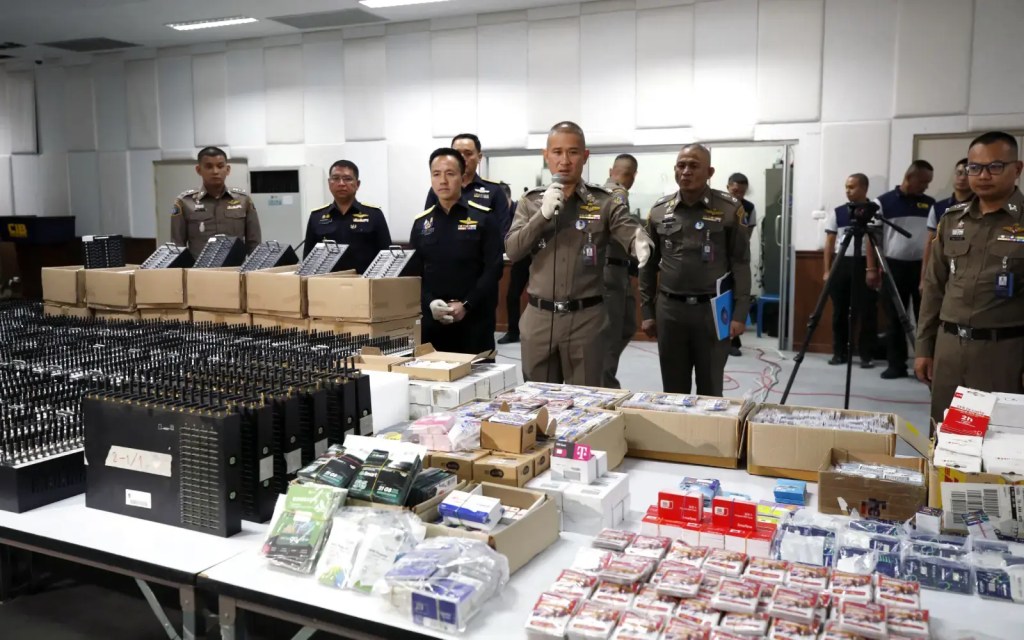
The joint operation comes in the wake of intense Chinese pressure on Thailand to act against scam hubs located on the Myanmar side of its border with Thailand. China’s Assistant Minister of Public Security, Liu Zhongyi, recently visited Bangkok and Myawaddy, urging Thai authorities to sever electricity and internet access to known scam centers, and to accelerate the repatriation of Chinese nationals caught up in these operations. The Thai government has acted swiftly, shutting down power supplies to at least five major scam compounds, a move that disrupted operations but also exposed the sheer scale of these networks. Reports indicate that some 30,000 to 50,000 individuals may still be trapped in these compounds, underscoring the magnitude of the crisis.
Thailand appears to have finally acknowledged the reputational damage these scams have inflicted on its economy, particularly its tourism sector. The case of Chinese actor Wang Xing, who was lured to Thailand under false pretenses and then trafficked into a Myanmar scam center, sent shockwaves through Chinese social media and dealt a blow to Thailand’s image as a safe destination for Chinese tourists. With Chinese tourism contributing nearly 3.8 million arrivals to Thailand’s economy in 2024, the pressure to restore confidence has been immense. In response, the Thai government has not only repatriated scam workers but has also launched investigations into high-ranking officials suspected of colluding with crime syndicates.
A crisis years in the making
These scam centers did not emerge overnight. Their origins date back to the late 2010s when lax regulations and corruption in Cambodia enabled the rapid expansion of cyber fraud syndicates. When the Cambodian government, under international pressure, cracked down on these operations in 2022, many groups simply relocated to Myanmar, where the post-coup instability provided the perfect lawless environment for their resurgence. Since 2021, Myanmar’s civil war has deepened the problem, as both the military junta and its affiliated militias, such as the Karen Border Guard Force (BGF), have allegedly profited from protecting these scam operations. The BGF has been accused of providing security for these compounds in exchange for financial kickbacks, an allegation the group denies despite overwhelming evidence.
The financial scale of these scam networks is staggering. The US Institute of Peace estimated that cyber fraud operations in Cambodia, Myanmar, and Laos generate nearly $64 billion annually, with nearly $39 billion originating from Myanmar alone. These figures illustrate that the industry is not just a fringe criminal enterprise but a deeply embedded economic force in the region, with significant beneficiaries at multiple levels of governance and law enforcement.
Who benefits? The complex web of interests
At the heart of the issue lies the reality that many key actors in the region—both legitimate and illegitimate—have vested interests in these scam operations. Myanmar’s military regime, desperate for cash amid economic freefall and Western sanctions, has little incentive to fully dismantle the scam industry, as it provides a crucial revenue stream beyond traditional sources like jade and timber smuggling. The junta, which has faced a 25% drop in GDP since the 2021 coup and is grappling with foreign currency shortages, is unlikely to cut off such a lucrative income source. Local militia groups such as the Karen BGF have positioned themselves as both facilitators and enforcers, claiming to crack down on scams while allegedly relocating operations rather than truly eradicating them.
Thai officials, for years, turned a blind eye to scam compounds operating just across the border, despite mounting evidence of human trafficking and financial crimes. The recent crackdown suggests a policy shift, but whether it is motivated by genuine law enforcement efforts or diplomatic pressure from China remains unclear. Reports have surfaced indicating that at least five high-ranking Thai police officials are under investigation for receiving bribes linked to scam networks, reinforcing suspicions that this crackdown may be limited in scope and longevity.
Will the crackdown have a lasting impact?
History suggests that these operations will not disappear but will rather morph and relocate. The dismantling of scam centers in Cambodia led to their migration to Myanmar, and if pressure mounts in Myanmar, they could easily move elsewhere—Laos, the Philippines, or even underground within Thailand itself. Some reports already indicate that smaller scam compounds are being set up in the southern regions of the Philippines, where enforcement is weaker and corruption remains high.
Moreover, while the immediate focus is on repatriating foreign nationals and shutting down existing operations, there has been little discussion on tackling the financial networks that enable these scams. The rise of cryptocurrency and offshore laundering has made it even harder for authorities to track illicit financial flows. A recent Financial Action Task Force (FATF) report suggested that an estimated 40% of illicit scam earnings in Southeast Asia are funneled through unregulated digital exchanges, allowing the money to be moved freely across borders without detection.
The joint China-Thailand crackdown on Myanmar’s scam hubs is significant, but it remains to be seen whether it represents a genuine turning point or simply another short-lived attempt at enforcement. The structural conditions that allowed these networks to thrive—corruption, weak governance, and economic desperation—remain firmly in place. Without systemic reforms and financial transparency, we may soon see history repeat itself, with scam operations resurfacing elsewhere in the region, exploiting the same vulnerabilities that have fueled their rise for years.
Image credits: EPA Images
 Sino-Southeast Initiative