
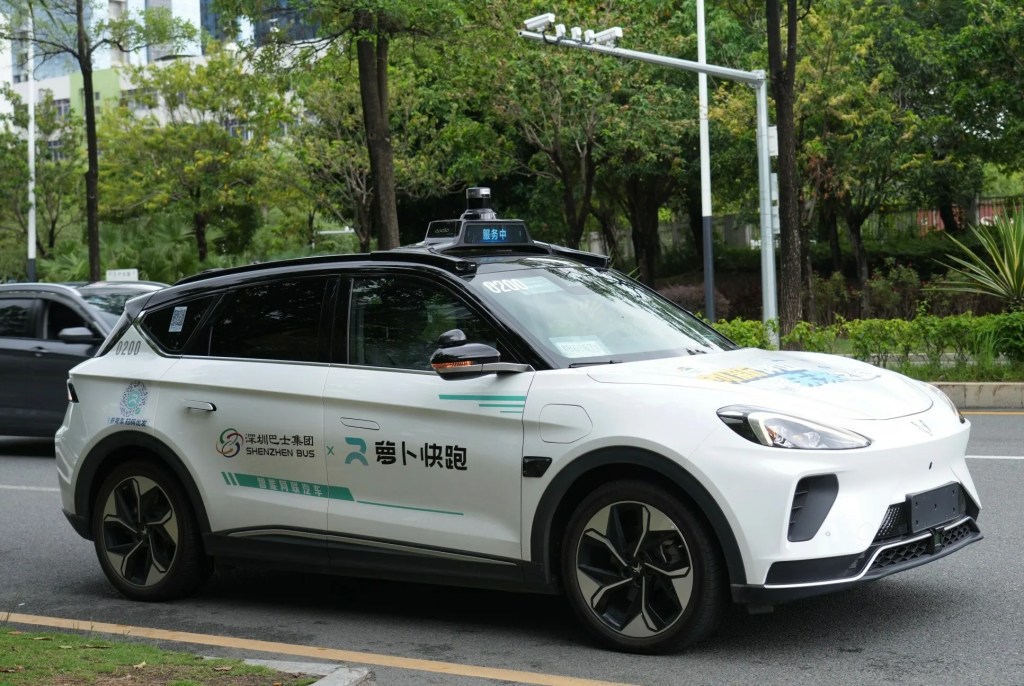
China stands at the forefront of autonomous vehicle innovation, propelled by fierce market competition and supportive regulations that encourage rapid technological advancement. As electric vehicles (EVs) have become ubiquitous in cities like Guangzhou, Chinese automakers are now pivoting toward autonomous driving technology as their primary competitive differentiator, potentially transforming not just China’s transportation landscape but the global automotive industry’s economic structure and value chain.
On the streets of Guangzhou, traces of gasoline vehicles are nowhere to be found. What you see are swarms of electric vehicles (EVs) moving around the city with their green license plates and minimalist designs. EVs surged into popularity and became mainstream in China about five years ago, and they have since become an inseparable part of the society and economy. This rapidly evolving industry is on the brink of another breakthrough. This time, in autonomous driving.
The story of the Chinese EV sector’s pivot towards autonomous driving begins with the fierce competition between automakers, leading to “price wars,” a race to the bottom where auto companies aggressively cut costs to attract customers. No firm desires to operate in this market, as companies face millions in quarterly losses in hopes of outlasting their competitors. Under such conditions that mimic a perfectly competitive market, companies must innovate their way out of their losses and build a durable competitive moat to survive and thrive. With driving range and software features becoming increasingly similar across EV brands, advancement in autonomous driving technology represents the true competitive edge.
Autonomous driving operates on a scale from 1 to 5, ranging from driver assistance to full self-driving automation. Level 1 offers basic features like adaptive cruise control, while Level 2 adds capabilities such as lane-keeping assistance but still requires constant driver supervision. Level 3 allows drivers to temporarily disengage under specific conditions, Level 4 enables full autonomy within limited operational domains, and Level 5 represents complete autonomy in all conditions. Currently, most Chinese EVs have achieved Level 2 capabilities, and many firms are pushing towards Level 3. The shift to Level 3 might come sooner than expected. He Xiaopeng, the CEO of the EV maker XPENG, says that autonomous driving is on the cusp of a “ChatGPT moment” when the technology becomes mainstream.
Mr. He’s exuberance is backed up by two structural tailwinds in the Chinese EV market. First, the country benefits from intense competition that pushes companies to embrace rapid innovation to survive, as companies like BYD, XPENG, Nio, Xiaomi, and Huawei are locked in battles to offer the most advanced driver-assistance systems (ADAS). In large part aided by competition, self-driving features that might cost an additional $8,800 on a Tesla are becoming standard offerings. Due to competitive pressures, even BYD’s sub-$10,000 vehicles now include advanced ADAS. Huawei’s ADS 2.0, for example, now has zero-dependency on HD maps, meaning that the car can drive autonomously in any city without prior mapping, a feat which Tesla’s Full Self-Driving (FSD) is still struggling with.
Second, this intense market competition is supported by a favorable regulatory framework that is best characterized as “innovate now, regulate later.” These policies have created a fertile environment for companies like Baidu, Pony.ai, and WeRide to develop and test autonomous driving technologies. By August 2024, the Ministry of Public Security had designated 32,000 kilometers of roads for autonomous vehicle (AV) testing and issued 16,000 licenses nationwide. This represents a substantial increase from just 5,000 kilometers in 2020, demonstrating the government’s commitment to rapidly expanding testing infrastructure. At least 19 cities are currently testing robotaxis and robo-buses, with local governments often competing to attract AV companies through favorable regulatory frameworks and infrastructure investments.
The city of Guangzhou alone has established 933 testing roads covering approximately 1,980 kilometers and drafted regulations for intelligent connected vehicles (ICVs) to facilitate roads that accommodate both human and automated driving. The city has embraced a “pilot zone” approach, designating specific areas where autonomous vehicles can operate under more permissive regulatory conditions, allowing companies to gather real-world data while minimizing risk. Baidu’s Apollo Go ride-hailing robotaxi service is already operational in multiple districts, offering services at competitive rates compared to traditional taxis. By mid-2024, 50 autonomous buses had completed 525,000 trips covering 1.74 million kilometers, demonstrating the scalability and reliability of these systems in real-world conditions.
Competition and favorable regulation working in tandem produce a cycle of continuous technological advancement that leads to more innovations that benefit consumers. For instance, these favorable regulations are already having a positive impact on data collection, with Chinese EV companies having accumulated more than 32 million kilometers of autonomous driving test mileage in the city of Beijing. Such data is then used by companies like Baidu and Pony.ai to train increasingly sophisticated machine learning models, creating custom simulation environments that can generate billions of virtual testing miles.
The data also provides useful insights into ways of reducing costs from design and operation. Baidu’s Apollo Go exemplifies this progress, having reduced its sixth-generation robotaxi cost by approximately 60% compared to the previous generation, now priced at around 200,000 yuan ($28,169). This dramatic cost reduction stems from vehicle redesign (like removing steering wheels) and economies of scale, as components once considered specialized become standardized. The company has also incorporated foundation models (similar to Large Language Models but for driving) into its systems, claiming safety performance ten times higher than human drivers. These models process multimodal inputs, combining visual, radar, and lidar data, to create comprehensive environmental understanding that surpasses human perception in many scenarios.
Market projections suggest autonomous vehicles will dominate China’s market. Goldman Sachs estimates that by 2040, 90% of cars sold in China will be AVs of Level 3 or higher, which will transform not just personal transportation but logistics, public transit, and urban planning. Companies like Baidu are already developing models supporting Level 4 autonomous driving, with plans to deploy thousands of robotaxis in major cities by 2026. The Chinese government has set ambitious targets, aiming for 30% of new vehicles to have Level 2+ automation by 2025 and 70% by 2030.
However, this evolution raises important questions. First, where does responsibility lie in the event of an accident, with the driver or the manufacturer? Experts increasingly suggest liability rests with automakers. Mercedes, for instance, has announced it will accept legal responsibility for accidents involving its Level 3 autonomous driving system when used as intended.
Second, how will value distribution in the industry shift? Currently, most of the value in the industry is captured by firms that excel in engine or battery manufacturing. As autonomous driving becomes dominant, will computer hardware manufacturers like Nvidia (producing GPUs for real-time data processing) and software developers capture more value? This scenario appears increasingly likely and would fundamentally transform the auto industry’s economic structure.
While specific details remain uncertain, AVs clearly represent the auto industry’s future trajectory, with China poised to play a major role alongside American firms like Tesla and Waymo. The rapid pace of innovation, supportive regulatory environment, and fierce competition in China’s market create ideal conditions for autonomous driving technology to flourish. As these technologies become more affordable and widespread, they will certainly revolutionize China’s transportation landscape as well as the nature of transportation as we know it.
Image credits: Baidu Inc.
 Sino-Southeast Initiative