
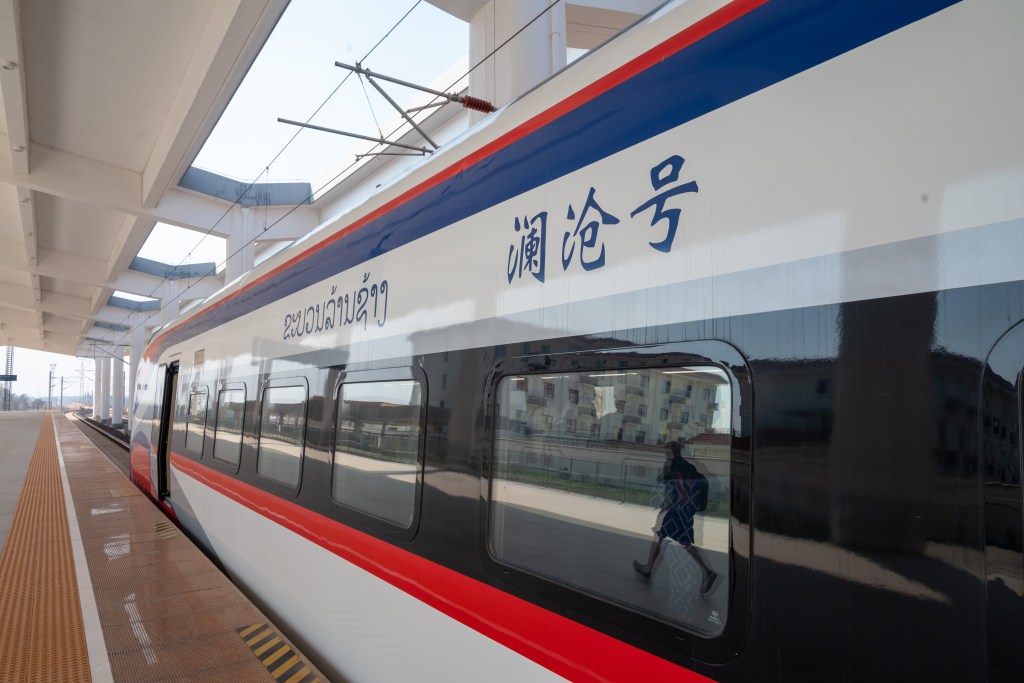
Despite its “win-win” branding as a flagship Belt and Road link transforming Laos from “land-locked” to “land-linked,” the China–Laos Railway has deepened asymmetric power dynamics. Thousands of Laotian families have been displaced, Laos’ 30 % ownership stake was financed by onerous Chinese loans that trap it in debt, and both Laotian and imported Chinese workers endured chronic wage delays and unsafe conditions. Rather than fostering inclusive growth, the project exemplifies how large-scale BRI infrastructure can trade away sovereignty for connectivity, embedding leverage through opaque financing, land control, and labor exploitation.
Marketed as the flagship project of China’s Belt and Road Initiative (BRI), the China-Laos Railway connects Kunming in China’s Yunnan province to the Laotian capital, Vientiane. Since its opening in December 2021, the railway has carried over 43 million passengers and 48 million tons of cargo, positioning itself as a symbol of China’s growing regional influence and global development ambitions. Backed by three Chinese and one Laotian state-owned enterprise (SOE), the project is framed as a “win-win” success—one that transforms Laos from “land-locked” to “land-linked” and promises mutual prosperity. But the story on the ground tells a different tale. Far from fostering inclusive development, the railway entrenches land displacement, deepens Laos’ financial dependence on China, and exploits both Laotian and Chinese laborers in the process.
China’s narrative around the China-Laos Railway is meticulously constructed. State media outlets like the Xinhua News Agency and China Central Television (CCTV) portray the project as a “Golden Corridor” of prosperity: one that brings connectivity, cultural exchange, and economic vitality to the region. Promotional videos feature traditional Laotian dance performances on board the trains. Official press releases emphasize three core themes: 1) “closer cultural exchanges”; 2) “seamless connectivity and 3) infrastructure integration,” and “more dynamic economic development.” This branding also extends beyond China’s borders. International-facing outlets like China Daily echo the same themes in English and various other languages to shape global perception. Political cartoons circulated by CCTV flip the “debt-trap diplomacy” critique often touted by the West back onto the United States, casting China as a “benevolent development partner” rather than a coercive creditor. The official discourse frames the project not just as infrastructure, but as the necessary process to transform Laos from being “land-locked” to “land-linked”. By transforming a geographic inhibition into a story of national progress, China positions the railway as a gateway to modernization and regional integration. The Laotian government, for their part, has embraced the narrative, presenting the railway as a catalyst for modernization and national pride. The Laotian administration’s welcoming attitudes towards Chinese investment has positioned themselves as more than a mere recipient of the development aid. Rather, they are an active participant in the China-Laos Railway project. However, this image of “win-win” cooperation obscures the uneven power dynamics and material costs embedded in the project.
Behind the glossy branding of the China-Laos Railway lies a more uncomfortable reality: land dispossession, debt entrapment, and exploitative labor practices. To make way for the railway, more than 3,800 hectares of land were expropriated, and over 4,411 families were displaced. In places like Luang Prabang, residents were displaced multiple times over the years as large-scale connectivity projects advanced. While official narratives celebrate regional integration, many Laotians have paid for it with their homes and farmland. Furthermore, the financing model of the railway only deepens this imbalance. Laos holds a 30% stake in the project, but had to borrow immense sums from Chinese lenders just to fund its share. With US$465 million in loans from China Exim Bank alone, Laos finds itself locked into long-term financial obligations that leave it little fiscal room for maneuver. Unlike other forms of multilateral development aid from the West, China’s bilateral financing concentrates leverage, giving Beijing disproportionate influence over national infrastructure decisions.
Labor conditions tell a similar story. China’s SOEs subcontracted the railway’s construction to Engineering Procurement Construction (EPC) contractors and middlemen—known as laobans—who fronted their own capital and bore the financial risk of delays. The laobans would fund the bottlenecks from Chinese banks trickling down the supply chain, which would ultimately lead to the withholding of wages and growing precarity for both Laotian and Chinese laborers on the ground. For many Laotian workers, delayed or reduced wages became the norm, and only the few who dared protest would be eventually paid. Meanwhile, Chinese workers, who were brought in under precarious terms, faced exploitative hours and even fewer options for recourse. As a result, both groups became disposable under a system where accountability is diffused, but the costs are local and immediate. Though resistance has not been absent. In 2023, more than 100 displaced northern Laos families refused resettlement after they lost their homes to the Lao-China Railway, as well as the unprecedented wave of protests, triggered partly by the government’s reckless spending on expensive infrastructure projects, like the China-Laos Railway. These expressions of dissent thus reveals the growing gap between official discourse and lived realities. Therefore, instead of delivering “equitable development” and “prosperity,” the China-Laos Railway has only reinforced structural inequalities under new branding.
The China-Laos Railway is not just a developmental project, it’s a case study in how infrastructure projects can be wielded as a tool of influence. Promoted as a “win-win” initiative, the railway has revealed how Beijing’s development model concentrates power through asymmetric financing, land control, and labor exploitation. But this is not unique to Laos. From Cambodia to Sri Lanka, China’s BRI projects often follow a similar playbook: promise prosperity, brand it as an equal partnership, and embed leverage beneath the surface.
While Western institutions have their own histories of unequal development practices, China’s approach is distinguished by its speed, opacity, and scale. Laos’ limited engagement with Western financial institutions like the IMF or World Bank reflects a deeper structural dilemma. With an economy burdened by existing debt (most of which are owed to China), Laos likely faces significant barriers in meeting its impending debt service requirements, which would qualify them for accessing more favorable terms from multilateral lenders. Authoritarian dynamics within its political system further discourage the transparency and policy reforms often required by Western-backed loans. As a result, Laos finds itself locked into Chinese financing, caught between limited Western options and rising dependency on Beijing.
For smaller Southeast Asian states, the lesson is clear: grand infrastructure does not come free. The real cost lies in sovereignty traded for connectivity, massive debt masked as partnership, and growth narratives that silence the displaced. As the BRI enters its second decade, the question is no longer whether China can build. It is whether those it builds for can afford what follows.
Image credits: Wikimedia Commons / Dominik Landwehr
Calleigh Pan
Calleigh Pan is a research assistant at the China Governance Lab and a compliance director at the G7 Research Group, where she leads compliance analysis on democracy commitments addressing transnational repression. Her broader research interests include authoritarianism, international security, global governance, and the greater China region. She is currently studying at the University of Toronto, Munk School of Global Affairs & Public Policy as a President’s Scholar.
 Sino-Southeast Initiative