
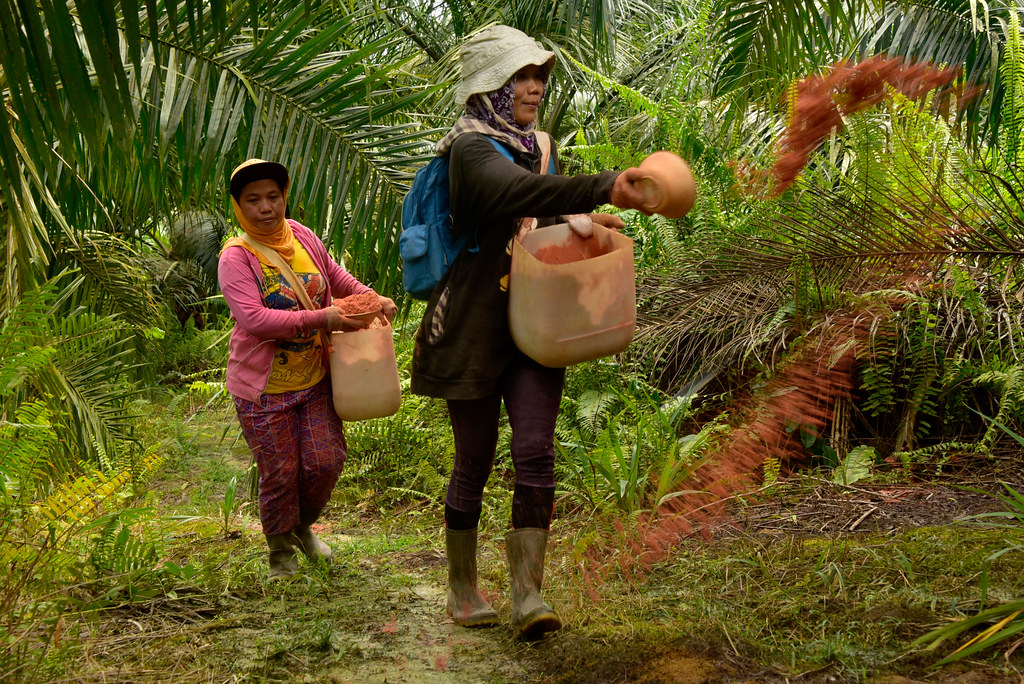
In July 2025, Indonesia transferred 400,000 hectares of seized plantation land to a state-owned palm oil company. Just weeks earlier, President Prabowo Subianto urged the country to expand palm oil production without worrying about deforestation. At first glance, this may seem like a routine economic decision to support a key export. But palm oil in Indonesia is not just an agricultural commodity. It is a political tool, a legacy of colonial extraction, and a vehicle for elite consolidation. This is not a story about market efficiency or sustainable development. It is a story about how power is built, preserved, and justified—often at the expense of land, people, and the environment.
Indonesia is the largest producer of palm oil in the world, accounting for 54% of global exports, a lasting legacy of Dutch colonialism, which brought over the first palm oil seedlings from Java, Indonesia. This growth is not the result of organic economic evolution, but rather thrives on deliberate political engineering fueled by global financial institutions, multinational corporations, and domestic elite interest in a new form of corporate-state collusion, with echoes of the colonial-era economic structures. In July 2025, the Indonesian government transferred over 400,000 hectares of seized plantation land to the state-owned entity Agrinas Palma Nusantara, expanding its control to more than 833,000 hectares. Just weeks earlier, President Prabowo Subianto publicly endorsed large-scale palm oil expansion, urging the nation to proceed “without worrying about deforestation.” These two developments signal a disturbing reassertion of state-led support for extractive growth.
In this article, we look at how global development banks and multinational corporations played a deliberate role in creating conditions for the Indonesian economy’s systemic dependence on the palm oil industry, through a mix of development projects in the 1960s and political patronage. The expansion is further facilitated by a narrative of “remoteness” and the myth of the “lazy native” to justify the means of economic coercion backed by the authority of the state, by terming the Indonesian Palm Oil Industry as a “strategic asset.”
State and International Institutional Support for Plantation Expansion
The Indonesian state has played a central role in facilitating the expansion of palm oil plantations, positioning the industry as a pillar of national economic development. Today, palm oil accounts for over 4.5% of Indonesia’s GDP and directly or indirectly employs nearly 16.2 million people, owing to its labour-intensive nature. This growth trajectory reflects deliberate policy choices made by the Indonesian government, the World Bank, and the International Monetary Fund (IMF), particularly after Sukarno’s takeover in the 1960s, and the aftermath of the 1997 Asian Financial Crisis.
In particular, the International Monetary Fund (IMF) in a 1998 letter to the Indonesian government, explicitly called for the removal of “all formal and informal barriers to investment in palm oil plantations” in a bid to revive economic growth in the aftermath of the 1997 Asian Financial Crisis. The result is creating an economic framework where growth without palm oil is unimaginable. Furthermore, the World Bank classified palm oil as a ‘development crop’ to alleviate poverty and fuel growth, with the Bank spending over $1 billion since 1965 to expand production in Indonesia. The effort was part of a larger scheme to integrate Indonesia into the liberal economic order, post the country’s bloody transition from the postcolonial government under Sukarno to a pro-West authoritarian regime under General Suharto.
In the present day, institutional support continues to be evident with “the expansion of oil palm plantations in Indonesia over the last several decades has been characterized as “breath-taking,” with the total area growing from under 2 million hectares in 1997 to over 8 million hectares by 2010.” The role of global financial institutions and foreign multinationals further pushes Indonesia’s economic dependency on palm oil exports, preventing investment and support in other productive economic areas. Massive foreign investments by Wilmar International and ADM create pressure on the entire system, as their investments in the countries have become systemically embedded in the country’s economic outlook, with many Indonesian Banks and other local firms benefiting from tertiary services provided to these companies. As Martin Fougère points out, ”Indonesian private sectors have now become the biggest investors, often supported by international investment banks and funds.” This indicates that post-1965, global institutions and corporations fueled the boom in the Indonesian palm oil industry, yet with the boom, the Indonesian economy became systemically dependent on the sector, resulting in Indonesian investors swooping in to benefit from the system.
None of this occurred in isolation, as the global institutions and multinational corporations benefited massively from the political patronage of the palm oil sector. This is evident by the number of subsidies awarded to the industry, with many corporations enjoying virtually free-of-charge access to state-claimed plantation land, for 35 years and renewable. According to Eilenberg, the collusion between states and corporations has resulted in the creation of ‘zones of exception’ for multinationals. Wilmar, along with other agribusiness firms, “leverages political connections to avoid legal repercussions, ensuring that state agencies remain hesitant to regulate corporate land claims.” Despite changes in government and the fall of General Suharto’s pro-West authoritarian regime in 1998, the state-corporate apparatus remains intact. Rather than terming Indonesia’s dominance in palm oil as a natural progression, it is a deliberate effort to exploit Indonesia’s natural environment and local communities, leading to the present condition.
“Lazy Native Myth” and “Remoteness” as a Tool of Dispossession
The discourse surrounding the development of palm oil plantations intentionally sets political narratives to fuel investment in the industry, with development frequently taking place in areas that are classified as “remote” or “frontier”, particularly the Sumatra and Borneo islands, ignoring the fact that these are inhabited by local communities with thriving agrarian economies. Corporations and the state strategically frame certain territories as ‘underdeveloped wastelands,’ arguing that they require corporate investment to become economically viable.” This discourse allows the state to legitimize the establishment of plantations, resulting in the displacement of indigenous communities who have been the rightful owners of the land for centuries, now being seen as barriers to progress.
The Indonesian government by the 1990s, actively framed palm oil as crucial for national development as a central theme, justifying deregulation and weakened environmental land protections in exchange for the narrative of bringing jobs and development to remote areas. An early attempt to balance equity and growth came through the Nucleus Estate Scheme (NES) of 1977, which allocated 80% of plantation land to smallholders. However, corporate actors lobbied successfully to reverse these proportions by the 2000s. However, many corporations disliked this arrangement, arguing that smallholders were unruly and more difficult to negotiate with alongside producing lower yields, thus lobbying for a change of policy. Around the 2000s a shift took place, with the government moving to benefit corporations rather than pursue the agenda of development and equitable growth. Currently, under a ‘partnership’ model, the roles are reversed, with the corporations only needing to allocate 30 per cent of the holdings to smallholders, reversing a landholding pattern from nearly 70 per cent in favour of smallholders to a paltry 30 per cent in the present day.
The shift in policy took place despite empirical evidence contradicting this claim, showing that smallholder farms are often more productive and environmentally sustainable than corporate plantations. At the heart of the success of this policy shift lies the myth of the ‘lazy native’ a colloquial term of the colonial era, used by the Dutch in Java to force natives to produce higher quantities of coffee, arguing that force was necessary to achieve higher production. Similarly, corporations successfully portrayed smallholding farmers as unproductive, and that they must be replaced by large-scale plantations to increase productivity and profits. Critically, plantations are often less productive per acre than smallholder farms, yet indigenous farmers are framed as incapable of managing land efficiently, legitimizing their dispossession. The “lazy native” myth of the colonial era continues to play a significant role in establishing a neo-colonial discourse, this time sustaining corporate colonialism and justifying a reorientation to large-scale plantations. The policy shift from smallholder-centred development to corporate plantation dominance illustrates how political discourse and myth-making, rather than purely economic efficiency, have shaped land tenure and production models.
From Colony to Corporation
Indonesia’s palm oil industry is not just a narrative of economic growth, but rather a larger story of deliberate corporate-state collusion, where global institutions, multinational corporations, and state policies facilitate resource extraction at the expense of indigenous communities, representing a neo-colonial setup. The World Bank and IMF’s promotion of palm oil as a development crop, and subsequent exploitation by Wilmar International and other players, have led to massive profit accumulation while smallholder farmers bear the economic, social, and environmental costs. On a fundamental level, this model mirrors colonial-era extraction, wherein a foreign entity sets up operations in a country, extracting their resources, and disrupting their way of life, while claiming economic growth leads to improvement in the lives of locals, and thus, is a repackaged version of colonial-era economic structure, or neo-colonialism by corporate entities.
This is perpetuated by the deliberate construction of “remoteness” as a tool to justify land dispossession by framing these regions as “underdeveloped”, and positioning corporate plantations as the only viable alternative to bring jobs and economic growth to the region. The reversal of the Nucleus Estate Scheme (NES) by the early 2000s, brings to light how state policies originally designed for equitable growth were dismantled through corporate lobbying, reflecting a broader trend of political patronage, and state-corporate collusion. Alongside ‘remoteness’ the colonial-era ‘lazy native’ myth served as a tool and justification for land accumulation, with the reversal of the NES policy, where smallholders were framed as unruly and inefficient, paving the way for large-scale corporate plantations.
While it may be tempting to classify the situation as a natural evolution of Indonesia capitalizing on its resources to fuel economic growth, Thailand provides a counterexample. Despite being the world’s third-largest palm oil producer, Thailand has no corporate plantations and supports smallholder farmers directly through state policies and services. Additionally, Thailand was never directly colonized, and this comparison underscores the argument that Indonesia’s palm oil dependency is not inevitable but deliberately politically and economically engineered over decades, echoing its colonial past. In conclusion, Indonesia’s palm oil industry is not merely a tool for national development but represents how discourse, backed by global institutions and neo-capitalism, evolves into a powerful political tool, with remnants of colonialism emerging in a new form of corporate colonialism. Without intervention from global institutions, reforms in global resource supply chains, or a shift in governance to a sustainable economic model, this exploitative structure is likely to persist, further relegating Indonesia to exploitation and the periphery of the global economy.
Image credits: Flickr
Arnav Singh
Arnav is an undergraduate student at the University of Toronto, pursuing a double major in Economics and Strategy. Originally from New Delhi, Arnav has served as an Assistant Director at multiple debates and Model UN Conferences hosted by Harvard, Yale and Oxford. Currently, he is a competitor on the Rotman Case Competition Team, and is interested in international politics and macroeconomic policy.
 Sino-Southeast Initiative