
As Indonesia’s working class began to unravel the entrenched corruption embedded in its national legislature in early August 2025, memories of the racialized violence of 1998 surged back into public consciousness– years when the ethnic Chinese community bore the brunt of civil unrest. Yet amidst these echoes of the past, something unprecedented occurred. Instead of allowing the familiar cycle of fear, rumour, and scapegoating to cascade into violence, Indonesians from across different backgrounds pushed back to protect one another. Under the hashtag #WargaJagaWarga (“Citizens Protecting Citizens”), ordinary Indonesians fact-checked viral claims, coordinated mutual aid, and amplified calls for calm. In a climate historically vulnerable to racial and religious tension, this movement offered a glimpse of what an inclusive and community-centered conception of security could look like–one not built by the state, but through civilian solidarity.
Remembering 1998, Recontextualizing 2025
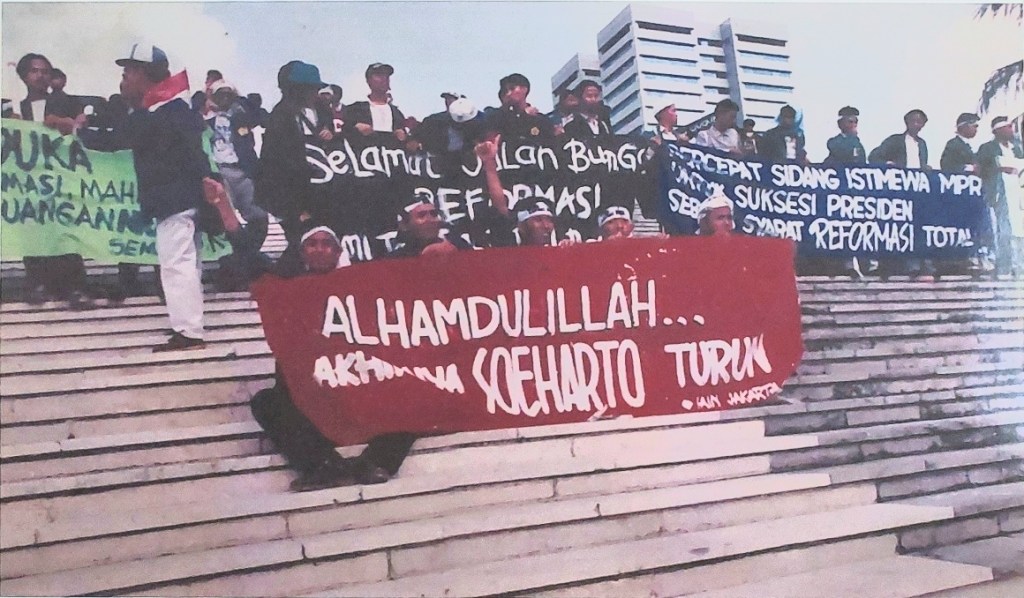
The May 1998 riots were a chapter of targeted violence against ethnic Chinese Indonesians, arising from the political and economic unrest of the Asian financial crisis. The shadow of this violence, fueled by mass unemployment and inflation, has long loomed over Indonesia’s conscience.
It was against this backdrop of historical scapegoating–the hostile tactic of characterizing an entire group of individuals according to the unethical or immoral conduct of a small number of individuals in that group–that a 2025 political maneuver became especially concerning: an effort spearheaded by Minister of Cultural Affairs Fadli Zon to publicly deny the atrocities and revise the official account of the period. As Amnesty International noted, Zon’s act of denialism risked erasing a foundational segment of Indonesian history and created an environment for past partisanship to reemerge.
These fears of historical repetition grew more urgent as widespread protests over corruption within the House of Representatives (DPR) erupted in August 2025. Tensions especially sharpened on August 28 after an online-delivery driver, Affan Kurniawan, was fatally struck by an armored police vehicle during the Jakarta demonstrations, an incident that quickly became emblematic of the state’s heavy-handed response. His death intensified public outrage and heightened the risk that political actors might again resort to diversionary or scapegoating tactics amid mounting pressure.
However, in a critical departure from the past, Indonesian society was forced to confront its past as it set the stage for a new, unprecedented response. Instead of succumbing to the patterns of 1998, this response was rooted not in the government, but in civilian solidarity.
Disinformation and Digital Psy-Ops
During the 2025 protests, social media feeds were inundated with alarming but unverified claims: alleged kidnappings near Jakarta’s Chinatown district of Glodok, looting attributed to “Chinese provocateurs,” and fabricated accusations of sexual violence intended to inflame tensions.
These tactics are not new. The ethnic Chinese community in Indonesia, shaped by Dutch colonial-era economic roles as traders and middlemen, has long held visible economic influence while remaining a socially marginalized minority. This intersection of economic prominence and social vulnerability has made the ethnic group a recurrent target of scapegoating during periods of economic and political crisis— a pattern spanning from President Suharto’s era (1967-1998) and into the present.
For instance, in the months leading up to the May 1998 riots, rumors and propaganda falsely accused Chinese Indonesians of hoarding food and wealth amid the Asian Financial Crisis. Senior military and government officials, through veiled references to “rats” and “traitors” and public statements targeting prominent ethnic Chinese business figures, endorsed these narratives. This subsequently fueled public resentment and contributed to the widespread violence enacted upon Chinese-owned shops, homes, and businesses.
Yet, despite the striking similarities between the tensions of May 1998 and August 2025, the public reaction proved fundamentally different.
Rather than echoing panic, Indonesian netizens–Chinese and non-Chinese alike–began routinely debunking these false claims. Verified accounts, community organizations, and independent journalists coordinated to fact-check viral posts, while neighborhood groups disseminated real-time updates, identified manipulative narratives, and urged caution before sharing unconfirmed information. The result was a notable reversal: Indonesia’s historical trauma appeared to have fostered collective vigilance rather than renewed susceptibility.
Following years of navigating media hoaxes and paid political “buzzers”–a term for online influencers and sockpuppet accounts paid to dominate discourse–the nation’s evolving civic literacy blunted the effectiveness of the digital psychological operations. Despite the nation’s economic anxiety, attempts to inflame anti-Chinese sentiment failed to gain traction. This resilience was a result of a society that, through increased digital access and exposure to global information flows, had grown increasingly capable of discerning truth. As Chinese diasporic anthropologist Charlotte Setijadi observed, the period revealed a dynamic of “old trauma, new solidarity,” wherein attempts to revive historical scapegoating were met with community-oriented refusal–something that would come to define the August 2025 crisis response.
#WargaJagaWarga and the Rise of Civilian Solidarity
The heart of this transformation was the emergence of civilian-led protection efforts under the hashtag, #WargaJagaWarga, which translates directly to #CitizensDefendingCitizens. Originating as a mutual-aid hashtag during Indonesia’s turbulent natural disasters and the COVID-19 pandemic, it has evolved into a grassroots security framework during the 2025 protests–manifesting in actions such as residents guarding neighborhoods in Bandung and Jakarta to maintain order. While tech-savvy netizens used it to create eye-catching infographics online to inform not only fellow Indonesians but also internet users worldwide, many also used it to crowdsource safety information, warn others of potential provocations, and counter fear-mongering narratives.
Examples proliferated rapidly with students sharing Google Maps routes with safe pathways home, whereas residents in majority-Indigenous neighborhoods reassured ethnic Chinese neighbors of their safety through public posts and direct messages. Many community figures and celebrities alike delivered food and transportation to stranded demonstrators while filming themselves dispelling rumors and encouraging unity. This collective action reflects longstanding sociological theories of scapegoating: when institutional trust is low, minority groups often become convenient targets to pin blame upon. Yet Indonesia’s 2025 experience suggests an inversion of this dynamic: rather than participating in the familiar cycle of blame, the public redirected scrutiny toward the actual agents of the crisis and demanded accountability from those responsible.
Theoretically, #WargaJagaWarga represents a shift from reliance on state-defined national security toward a model of community-based human security. It marks movement from institutions like the military– which have roots in historic, racialized violence–and toward a form of security grounded in empathy, participation, and shared responsibility. This concept aligns with the term “societal security,” or the ability of a society to persist in its essential character under changing conditions and possible or actual threat. In the Indonesian context, this means fulfilling the commitment rooted in the nation’s foundational principles of gotong royong (mutual assistance) and the Pancasila, the foundational philosophical theory that represents Indonesia’s ideology, tenet of Indonesian unity. This ideological foundation gives the movement a distinctly local resonance.
While momentous, it is necessary to note that #WargeJagaWarga is merely a band-aid. It is a symptom of institutional inadequacy as much as it is a triumph of civic solidarity. Its emergence highlights the strengths and the fragility of Indonesia’s socio-political fabric. And yet, for solidarity to become sustainable, institutional change is necessary. The government must move beyond rhetoric to genuinely embody the Indonesia First principle that the nation is built upon–shifting from a system that benefits government officials, the military, and the wealthy to one that delivers welfare for all.
Navigating Indonesia’s New Nationalism
The #WargaJagaWarga movement arrived in the midst of a complex phase of Indonesian nationalism. A post-pandemic Indonesia saw this nationalism moulded by several converging forces: a potent “Muslim-first” rhetoric, fragile political coalitions, and global trends of democratic backsliding. Domestically, President Prabowo Subianto’s administration balanced ambitious economic initiatives, such as infrastructure expansions, with alliances that increasingly included Islamist-leaning parties and conservative religious groups, creating tension with Indonesia’s pluralist ideals enshrined in its national ideology. This tension —neither regression nor progression— resulted in an absence of community trust.
Movements such as #WargaJagaWarga emerge precisely from this, filling the vacuum created by increasingly polarizing politics that compel citizens to take sides. When state narratives are contested through historical revisionism or ethno-religious appeals, citizens shoulder the burden of maintaining social cohesion. The 2025 protests revealed that Indonesia’s civic identity isn’t merely inherited from its constitution; it is actively negotiated, especially when institutions falter.
Conclusion
While the events of 1998 were defined by fear, instability, and the rapid collapse of social trust, the events of 2025 were defined—at least partially—by resilience, civic maturity, and the refusal to surrender to repeated patterns of scapegoating. Indonesia did not avoid the crisis; rather, the crisis illuminated how solidarity itself can operate as a form of security, enabling society to withstand volatility even when institutional protections falter.
While cautious optimism is understandable in moments like these, it must be balanced with a realistic appraisal of persistent challenges. The #WargaJagaWarga initiative represents a meaningful step toward community-based security, yet it cannot be seen as a definitive or lasting solution. Deep-rooted structural inequalities remain unaddressed, and the potential for elite actors to manipulate social tensions continues to undermine stability. Furthermore, the enduring historical trauma experienced by Chinese Indonesians shapes both individual and collective decision-making, influencing social dynamics in ways that complicate reconciliation.
Nonetheless, the 2025 protests revealed that entrenched patterns of conflict and marginalization are not immutable. The demonstrations in August illustrated that civilian solidarity can effectively prevent violence, challenging conventional notions of security that rely primarily on state authority and coercion. Instead, these events highlighted an alternative framework for public safety–one grounded in mutual care and inclusive community engagement within a pluralistic democratic context.
This phenomenon transcends simple optimism; it serves as a powerful reminder that the resilience of Indonesia’s pluralism hinges not on outdated institutions but on the proactive solidarity and mutual protection among its citizens. Moving forward, sustainable peace will require nurturing these grassroots commitments alongside meaningful structural reforms.
Image credits: CC0 public domain
Emily Adiwijaya
Emily Adiwijaya is an International Merit and Trinity One Scholar at the University of Toronto, where she studies Ethics, Society, Law (Pre-law), Public Health, and International Relations. She has completed a legal internship with SHP Lawyers and serves as a mentee in UofT’s Law and Mentorship Program. A national awardee in writing and newscasting, she is passionate about healthcare law, equitable access to care in conflict zones, and peace journalism.
 Sino-Southeast Initiative