
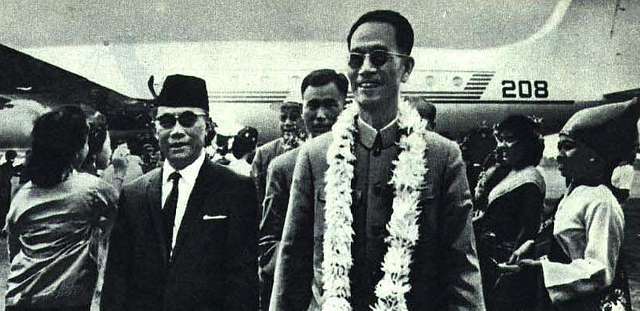
In the mid-1960s, mass killings in Indonesia were viewed as an effective security solution to the growing Communist Party and to critics of the Suharto regime. Backed by Washington, Indonesia’s military crushed perceived threats through coordinated violence–an approach later described by American journalist Vincent Bevins as the “Jakarta Method.” Despite the scale of death, the period’s most enduring legacy lies in the security architecture it produced: one that normalized repression, militarized dissent, and privileged regime stability over civilian protection across Southeast Asia and much of the Global South long after the Cold War ended. Contemporary US intervention in Venezuela showcases how unilateral force and selective legality continue to define what counts as “security.” The result is not only a regional inheritance, but a global one–where violence remains an acceptable instrument of international security and accountability remains optional for the global hegemon.
Jakarta, 1965: Indonesia’s Cold War Crucible
Between October 1965 and March 1966, approximately half a million Indonesians were killed. Suspected sympathizers of the Communist Party of Indonesia (PKI) were rounded up and executed in one of the most severe politicides in the nation’s history. While the killings began as an anti-communist purge, the category of victims stretched: members of Gerwani, a leftist and communist-aligned women’s organization focused on equality, labour rights, and anti-colonialism; accused kafirs, an Islamic term for “unbelievers” used to mark those who reject the faith; trade unionists; ethnic Chinese; and alleged leftists. Anyone the army and its civilian auxiliaries wanted gone.
The killings were not secret. Time magazine described the suppression of communism in Indonesia as “The West’s best news for years in Asia,” while Western diplomats praised the nation’s military for restoring order in the midst of chaos. The US embassy in Jakarta had been monitoring the PKI’s growth for years. It was the largest communist party outside China and the Soviet bloc and had mass organizations for workers, peasants, and women. They had been winning through legal means. From Washington’s perspective, a political dilemma had been resolved using a security solution.
It is important to clarify, however, that the United States did not directly order the killings but instead helped structure the conditions that enabled them to occur. Research and declassified documents showcase that Indonesian authorities and armed forces were on the receiving end of military aid and support from the United States, cultivating a pro-American faction internally. The intensification of intelligence cooperation during the months before the violence included the provision of lists of senior communist party officials, radio equipment, and money. Despite this, no one in Washington moved to stop the violence, and no senior official publicly objected. This silence signalled approval without explicit endorsement.
What emerged from the ashes was not only a durable dictatorship but a durable idea. An idea that internal political threats could be treated as military targets; that civilians who fell into the wrong political category could face the loss of their protection; that mass violence–if executed efficiently and shielded by the right geopolitical cover– could later be repackaged as stability. This was not counterinsurgency but something else that became available for export.
This raises a question that hasn’t been sufficiently answered: What kind of international security order treats mass violence not as a rupture, but as a working instrument? And what does it mean when the architects of such violence face no condemnations, no sanctions, and no tribunals but instead quiet cooperation, and, later, investment and praise?
The “Jakarta Method” as a Playbook
The term “Jakarta Method” emerged in 2020, but the logic behind the pattern was recognizable throughout the Cold War. Vincent Bevins assembled the archive and gave it a name, illustrating how Washington’s anti-communist prerogative produced a reproducible doctrine. What happened in Indonesia was not an isolated case, but a template designed for replication.
This logic is apparent in multiple currents. American advisors brought it to Latin America during the Cold War, where it resurfaced in Chile through psychological operations and election interference, and in Argentina through coup d’état backing that culminated in a military dictatorship. It also appeared in Asia beyond Indonesia, as exemplified by the US’s alliance with the Philippines’ president, Ferdinand Marcos, where concerns over authoritarianism were subordinated to the prioritization of US military bases and regional stability in the mid-Cold War period. It was also evident in Thailand, where US aid and influence under Prime Minister Thanom Kittikachorn, followed by American withdrawal, produced a fragile political opening lacking a durable democratic base that was vulnerable in 1976’s authoritarian reversal. And most notably in Vietnam, where US counterinsurgency blurred the lines between combatant and civilian, producing mass violence that never met consequence.
While each case had its distinct perpetrators and victims, Washington remained a common thread: providing training, sharing intelligence, extending diplomatic cover, and foreclosing accountability.
What made the Jakarta Method incredibly transmissible was not its brutality but its impunity. Regional militaries of the Global South observed that a government responsible for half a million deaths received aid, favorable trade terms, and optimistic relations with the leading victor of the Cold War. They drew the obvious conclusion; this method didn’t require direct US intervention and only necessitated that certain kinds of violence would remain without consequence. That assurance had been issued, in plain sight, in Indonesia.
This reflects a significant turning point in the Cold War, where the definition of security began to shift. Security now meant the elimination of threats, not the protection of populations. The average target was no longer an anonymous, armed insurgent hiding in the jungle but the labor organizer addressing a rally, a teacher assigning the wrong books, a woman wearing an incorrect organization’s badge.
Southeast Asian Security Beyond Indonesia
The Jakarta Method didn’t require active export. It was absorbed through observation. In the midst of the Cold War, all eyes in Southeast Asia were on Jakarta as leaders reconsidered their limits of what was possible, permissible, and what the United States would tolerate.
Despite their disparities, the results were patterned. Some states reacted directly: Marcos placed the Philippines under martial law in 1972, citing the communist threat, while Washington continued its security assistance. Likewise, the absence of meaningful condemnation from the US when the Thai military opened fire on student protesters at Thammasat University reflected a similar prioritization of Cold War stability over democratic principles.
And most distinctly in Vietnam. The Vietnam War was not a replication of the Jakarta Method; it was something larger. It involved the full mobilization of American industrial and military power against a perceived regional threat. Between 1965 and 1973, the United States dropped over 7.6 million tons of bombs and ordnance on Southeast Asia, exceeding the total used in World War II. This destroyed entire ecologies, displaced millions, and killed civilians on an unprecedented scale, and continues to do so through unexploded ordnance. The absence of reckoning following the war’s culmination was evident. There was no Nuremberg, and there was no consequence.
In other contexts, the pattern was more indirect. In Malaysia and Singapore–states shaped by their Commonwealth status—US influence operated through the endorsement of justifications for managing anti-communist insurgencies. In Malaysia, the continued justification of repression drew on the legacy of the Malayan Emergency and culminated in the negotiated end of the insurgency through the Hat Yai Peace Agreement in 1989. In Singapore, Cold War stability was secured through the provision of economic assistance and strategic integration into US containment efforts, while domestic measures such as Operation Coldstore were internally justified as necessary anti-communist safeguards.
While each trajectory was distinct, all bore the imprint of Indonesia’s precedent and the war that followed. Vietnam had shown the region something Indonesia didn’t: that the United States was capable of inflicting catastrophic violence, loss, and walking away without consequence. The message here was evident: aligning with Washington was a gamble, but defying it proved to be a deadlier risk.
These practices didn’t rely on sustained American patronage; they were internalized and institutionalized through doctrines and laws. Emergency provisions drafted as temporary measures remained, while military forces granted internal security roles proved unwilling to relinquish them. As the Cold War ended and the United States emerged as the hegemon of the new Liberal International Order, these structures remained in place, refashioned to serve local purposes.
What is often described as democratic backsliding in contemporary Southeast Asia is, in many cases, something older. It is not the erosion of a once-robust institution, but the continued operation of institutions designed for a different purpose, in a different era. This machinery was built to preserve regimes, protect elites, and quietly manage populations—and it is working exactly how it was intended.
Caracas, 2026: Power, Sovereignty, and Selective Security
Venezuela and Indonesia are not the same. The instruments are different—executive orders, sanctions designations, parallel diplomatic recognitions. The scale is also different—Venezuela’s victims are counted in economic collapse and forced migration rather than mass graves. But both cases possess the same underlying proposition, and it is worth stating plainly.
When a powerful state identifies a rising foreign opposition, it may act against that actor using whatever means it deems necessary. International law ceases to function as a binding constraint and instead becomes a discretionary resource, invoked when useful and set aside when inconvenient. Sovereignty is not an equal right possessed by all states; rather, it has become a privilege that can be earned and withheld from others. Security is defined by the actor with the capacity to enforce its definition.
This idea was not invented in Caracas when the United States launched a military strike and captured incumbent president Nicolás Maduro and his wife, Cilia Flores. It was refined in Jakarta, Santiago, Buenos Aires, and Saigon. It was embedded in the institutional practices that defined Cold War national security that remain disavowed.
The continuity between 1965 and 2025 is not direct causation but an inherited assumption. Cold War exceptions did not expire with the conflict that produced them. They became precedents—and precedents, when acknowledged, settle into permissions.
Impunity and the International Security Order
The conclusion of the Vietnam War without its own version of Nuremberg is indivisible from this discussion. The absence of consequence faced by the United States continues to mold the international system it leads. While some officials expressed regret, none were tried or held criminally accountable for constructing such violence. So, Southeast Asia watched. Its militaries observed that power dictates the rules of war, exempts itself from them, and enforces them selectively against the weak. And as a result, they adjusted their expectations accordingly.
This brings us back to Indonesia. What happened in 1965 established foundational assumptions about what Southeast Asian security—and by extension, what security in the Global South—looks like. This period set in stone who defines security and what methods are permissible in the pursuit of it. The Jakarta Method was not a glitch, but a demonstration of how international security actually works: a hierarchy of power, selectively enforced. Until that hierarchy is confronted and deconstructed, violence will remain the preferred recourse, impunity easy to secure, and security will continue to signify threat, not protection.
Photo Credits: CC/ Public Domain Media
Emily Callista Adiwijaya
Emily Adiwijaya is an International Merit and Trinity One Scholar at the University of Toronto, where she studies Ethics, Society, Law (Pre-law), Public Health, and International Relations. She has completed a legal internship with SHP Lawyers and serves as a mentee in UofT’s Law and Mentorship Program. A national awardee in writing and newscasting, she is passionate about healthcare law, equitable access to care in conflict zones, and peace journalism.
 Sino-Southeast Initiative