
In the late 1980s, Japan’s rise felt inevitable with the second-largest economy in the world. The country had in the past decades transformed into a manufacturing powerhouse, with its share of world trade increasing to nearly 10%. Then, the story flipped, as a currency shock collided with an asset bubble giving rise to zombie companies, and a nation that looked destined to overtake America instead spent the 1990s in stagnation, termed Japan’s Lost Decade.
China in 2025 is not Japan in 1989. Yet, it is drifting into the same kind of predicament, as an economy that has relied on an investment and export model for too long, comes to terms with a changing geopolitical environment with Trump’s tariff war. The risk is not a dramatic crash, rather something more quietly destructive, a decade in which stability becomes indistinguishable from stagnation.
Japan’s Lost Decade
In the early 1980s Japan looked like the most coherent ‘development success story’ in the world, an export driven productive economy, with the highest per capita income in the world, and predictions that Japan would soon overtake the United States. However, the boom was tightly linked to an export engine that depended on a favourable exchange rate, with the US Dollar appreciating nearly 50% against the yen in the 1980-85. Consequently, as the US trade deficit with Japan widened, political pressure in Washington escalated as American companies such as IBM and Caterpillar (CAT) requested the government to intervene. This culminated in the Plaza Accord, signed in New York on September 22, 1985 by the United States, Japan, the United Kingdom, France, and West Germany, agreeing to push the dollar down.
However, what took policymakers by surprise was the speed with which the yen strengthened, and as Japanese exports became more expensive abroad, with the economy sliding into recession in 1985-86. To cushion the shock in exports, policymakers tried to re-ignite growth at home by cutting interest rates from 5% to 2.5% in 1987. These moves helped fuel a credit-driven surge into stocks and property, with the Nikkei tripling to about 39,000 by 1989. By early 1989, inflation and speculation were running hot, and economist Paul Krugman noted,”Japan’s banks lent more, with less regard for the quality of the borrower, than anyone else’s. In doing so they helped inflate the bubble economy to grotesque proportions.” When the central bank tightened to stabilise prices, the stage was set for the crash and the long unwind that followed.
China’s Property Bubble and Similarities to Japan
China’s similarities begin with currency politics too, with a rare internal debate on the Yuan, as Chinese economists and former central-bank officials make unusually open calls for a stronger yuan, arguing that a stronger currency is necessary to wean off export dependence.This reveals that China’s leadership is wrestling with an internal dilemma, whether to move away from an export oriented growth model towards one where domestic demand must fuel economic growth.
Worryingly, the trouble is that China is trying to pivot while carrying a property crisis on its back. Japan’s Lost Decade was, in essence, a balance-sheet recession, as The Bank of Japan and the Japanese government decided to bail out the companies deemed ‘Too Big to Fail’, also called ‘Zombie Companies’. The term refers to companies that only have enough cash to cover their operating expenses but are unable to pay off their debt and have no capacity for further expansion, leading to stagnation.
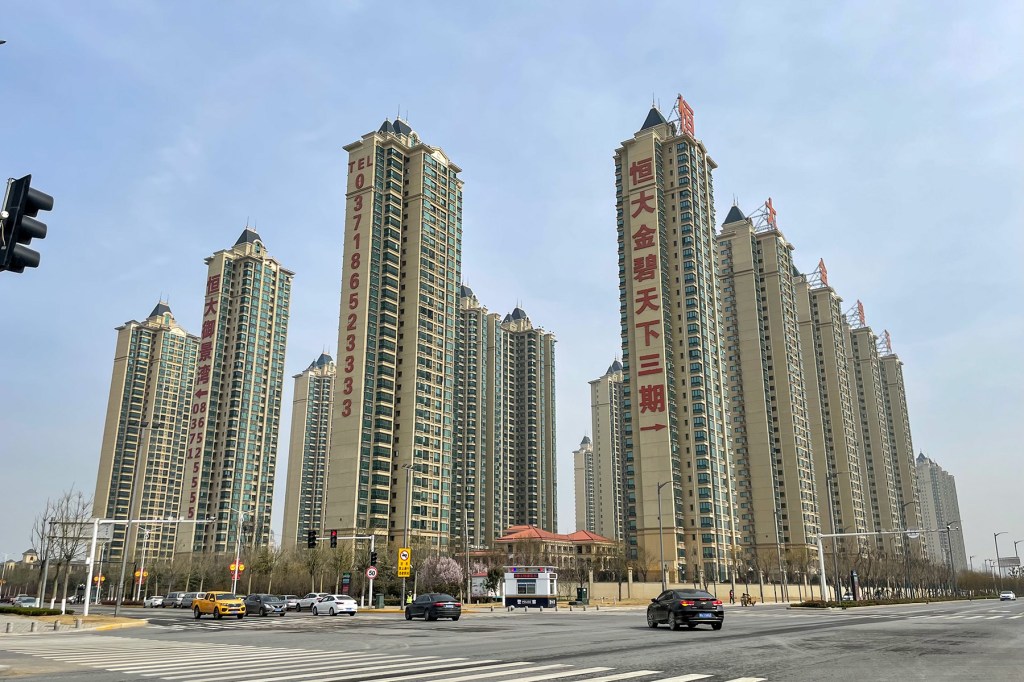
Arguably, in China, a similar risk plays out, with the property sector playing a similar role to zombie companies and asset bubbles. In 2021, Evergrande, one of China’s largest real estate firms collapsed under a massive debt burden exceeding $300 billion, triggering a broader housing market downturn. The fallout led to falling home prices, significant job losses, and plummeting investor confidence. Moreover, the crisis isn’t over, as property dominates household wealth, according to the IMF’s warning that roughly 70% of Chinese household wealth is concentrated in real estate. A critical area of instability lies within a vast network of local-government financing vehicles (LGFVs), entities owned by the state to fund infrastructure and other projects. The Reserve Bank of Australia estimates that LGFV debt currently stands around 50% of GDP, far larger than official local-government debt estimates. The risk lies in the scenario where investment becomes more politically chosen than economically justified and the returns that once made debt tolerable begin to disappear.
This is the kind of concentration that turns a housing slump into a consumption shock, which is a cyclical downturn resembling Japan’s liquidity trap. Beijing’s policy response so far has also echoed the Japanese instinct, prioritizing containment over restructuring. In November 2024, the Central Bank issued a $1.4 trillion debt package to support ‘hidden debts’ of LGFVs. On the other hand, in the property sector, the government has directed lending towards the completion of selected housing projects of developers plagued with debt. This comes at a time, when consumption growth slowed to 1.3% year-on-year, the weakest since December 2022, and economists have argued for larger consumer facing stimulus packages.
Headwinds and Tariffs
Unusually, financial markets have already started to price in something close to this story for China. In a startling inversion, bond yields have plunged to record lows and China’s 30-year yield has, at times, fallen below Japan’s. A hallmark of Japanification is not panic but resignation with long-term yields that drift lower because investors expect low growth and low inflation for a long time. While markets can be wrong, they are often early in noticing when expectations turn from “this will pass” to “this is the new normal”.
If China could rely on external demand to outgrow its internal economic risks, the risk of a lost decade would be smaller. This is another rhyme with Japan, as external pressure with Trump’s trade war intensified precisely when domestic rebalancing became most necessary. Economists estimate that reduced access to the U.S. market has cut China’s export growth by roughly 2 percentage points, equivalent to about 0.3% of GDP. A key risk would lie with Chinese policymakers, who are tempted to double down on industrial policy to counter the export shock, choices that can deepen overcapacity.
The IMF, watching this tension build, has pushed Beijing unusually hard toward a different answer. Most recently urging China to make what it called a “brave choice”: curb export dependence, boost consumption, accelerate structural reforms, and tackle the property crisis and local-government debt more directly.
Conclusion
This is the lesson Japan teaches most brutally, as The Lost Decade was not a single error, rather a series of policy equilibriums from protect the system from disorder today, accept weak demand tomorrow, to hope that time does the work that restructuring avoids. Japan eventually stabilised through zero interest rates, fiscal packages, repeated interventions but stability arrived with a price tag: years of deflationary psychology and a private sector that learned to expect disappointment.
China still has the room to choose differently, but the choice is narrower than it looks. A lost decade does not arrive with a headline, and Japan learned that too late. China’s danger is learning it slowly, by mistaking the absence of a crash for the presence of recovery.
Image credits: Wikimedia Commons / Windmemories
Arnav Singh
Arnav is an undergraduate student at the University of Toronto, pursuing a double major in Economics and Strategy. Originally from New Delhi, Arnav has served as an Assistant Director at multiple debates and Model UN Conferences hosted by Harvard, Yale and Oxford. Currently, he is a competitor on the Rotman Case Competition Team, and is interested in international politics and macroeconomic policy.
 Sino-Southeast Initiative