
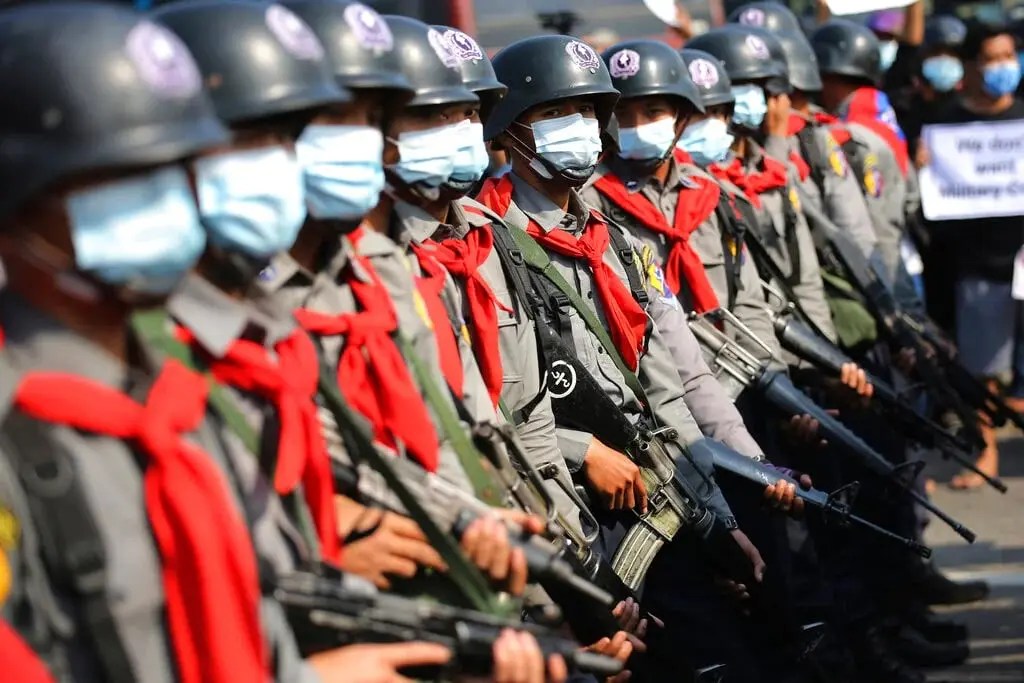
ASEAN is right not to engage in the Myanmar conflict more forcefully and should focus on its own initiatives without their problematic neighbor.
Since the inception of the current civil war in Myanmar, any discussion of ASEAN’s place in the world has unavoidably been paired with its inability to resolve the internal crisis of a member state. With each passing year of the five-point consensus being ignored by the Myanmar junta, the credibility of the ASEAN erodes in the eyes of the international public. The policy of non-interference of members’ internal affairs and consensus-based approach to decision making are seen as impediments to decisive action which might otherwise compel the military regime and other militant factions to cease hostilities and return to a civilian governing structure. Yet these views fundamentally misunderstand the nature of ASEAN as a regional organization and leads to misplaced expectations for what its member states can do to confront the Myanmar crisis. ASEAN is already doing all that it can to help resolve the crisis and should not forsake its mandate of driving regional prosperity by being obligated to engage further in a hopeless endeavor.
At its core, ASEAN was founded with a commitment to respecting each member’s sovereignty, enshrined in the policy of mutual non-interference of its member states. This was a sensible guideline given the diversity of countries’ sizes, developmental stages, and governing systems which make it inherently challenging to form a cohesive entity like the European Union. The resulting group has brought together communist regimes with capitalists, absolute monarchies and constitutional ones, and democracies of varying degrees. This leads to ASEAN’s ultimate reason for being: to unlock the underlying growth potential of this diverse bloc regardless of what goes on politically in each country. In this regard there has been significant success in the Regional Comprehensive Economic Partnership, the largest free trade agreement in the world.
In the face of such progress in trade and other ongoing initiatives to strengthen economic ties, there is no appetite for involvement in a conflict with minimal economic impact on the wider region. In this sense, each member’s approach to the Myanmar crisis is more united than its critics would give credit for. Despite the varying degrees of engagement with the Myanmar junta, no country is either willing or capable of putting tangible pressure on the regime or its opposing militant groups to reach a conclusive outcome in the civil war. That is to say, no member of ASEAN will be supplying arms or financing any faction involved in the war, aligning with the non-interference policy. History has shown how costly foreign interventions can be with no guarantee of achieving a decisive outcome. In a conflict as complex as the civil war in Myanmar, with the military controlling a mere 21% of territory, it would be unwise for any power to attempt to interfere lest Myanmar devolve into further chaos as Syria did at the height of its civil war.
Within this context, the five-point consensus plan, though ridiculed to oblivion, was the most that could have been done and nothing more should have been expected from ASEAN. The plan, which urged for an immediate cessation of violence, was non-binding and required voluntary participation from the warring factions. This was ignored, the fighting continued, and the nine other members of ASEAN agreed to leave Myanmar aside and resume working together on other initiatives. This is the ASEAN way precisely because there is nothing that the bloc can do to resolve the conflict if the belligerents are unwilling to restrain themselves.
This does not mean that ASEAN as a bloc has failed. This is, in fact, how the bloc is supposed to react to internal conflicts as stipulated by its founding policy. This principle is wisely being followed to ensure the rest of the region can continue the path to prosperity with minimized burden from a problematic member. As a parent would engage with a naughty child, Myanmar’s military regime has not been invited to the ASEAN forums or been included in regional initiatives since the coup occurred. The onus is on the military and the insurgents to stop fighting and be more receptive to a peaceful resolution. Only then can ASEAN step in to help mediate the conflict and bring the country back into the international community. Crucially, ASEAN should not be expected to micromanage these militant groups or be held responsible for the outcome of this civil war.
Nevertheless, the impact of the situation in Myanmar cannot be entirely cordoned off to its borders with nearby countries facing the brunt of the resulting humanitarian crisis. Bangladesh, Indonesia, Malaysia, and Thailand have seen thousands of refugees displaced by the war crossing into their borders. Scam centers proliferate in Myanmar’s border regions with workers being kidnapped from abroad and coerced to scam their victims. These are the situations that ASEAN and its member states should be focusing their efforts on. A concerted push to dismantle the scam centers and joint support in handling refugees are well within the scope of what ASEAN governments can do. Chasing the pipe dream of an ASEAN-led peace resolution in Myanmar is simply unrealistic given the situation on the ground and unnecessary as the bloc’s focus should remain on fostering economic linkages with willing and able members of its association.
Image credit: AP
 Sino-Southeast Initiative