
Guest Article by Jit Soon Aw
Once colonial, now collaborative: the EU and ASEAN are evolving history’s imbalance into a mutually lucrative partnership.
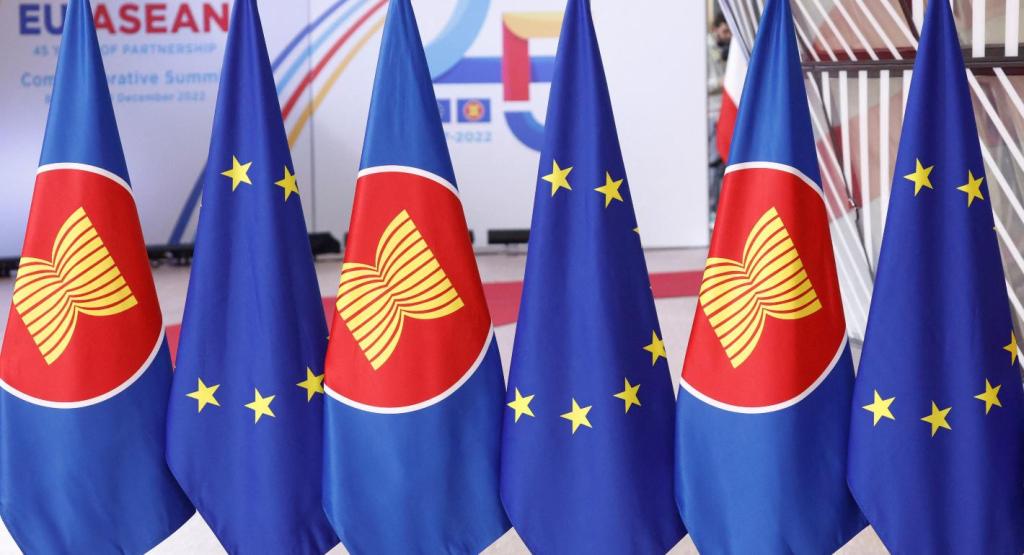
The Association of Southeast Asia Nations (ASEAN) and the European Union (EU) are undoubtedly two of the most successful regional blocs with the shared aim of enhancing cooperation and integration among diverse member states. Although the degree of regional integration differs significantly between the two, both are driven by a similar vision: to promote regional peace and security, and to enhance economic cooperation along their borders. While ASEAN and the EU are geographically distant, their interaction has grown significantly closer since the 1990s. What was once a colonial relationship has since evolved into a strategic partnership, with both the EU and ASEAN deriving concrete benefits that align with their respective regional interests. This partnership is primarily driven by two key factors: economic gains and strategic geopolitical considerations.
Before examining the underlying drivers of this relationship, it is important to recognise that, despite their similar aspirations, the EU and ASEAN differ significantly in their nature. The EU traces its origins to the European Economic Community (EEC) in 1957, an economic initiative aimed at creating a common market among war-torn European nations to promote economic growth, prevent future conflicts, and contain the spread of communism. The signing of the Maastricht Treaty in 1992 marked the EU’s formal emergence as a political project with supranational elements, uniting member states under shared commitments towards democracy, human rights, and the rule of law (outlined in the Copenhagen Criteria).
In contrast, ASEAN was established in 1967 in the context of heightened regional tensions, such as the Konfrontasi conflict between Malaysia and Indonesia, as well as the separation of Singapore from Malaysia. Its formation also occurred during the Cold War, where Southeast Asian countries like Vietnam were entangled in proxy conflicts between the United States and the Soviet Union. As a result, ASEAN’s primary objective was to safeguard the sovereignty of its member states, which gave rise to its three foundational principles: non-interference in domestic affairs, the peaceful settlement of disputes, and consensus-based decision-making (outlined in the ASEAN Charter).
Therefore, it has to be made aware that the EU and ASEAN differ in terms of their nature of integration, foundational principles, and political ambition. Against the backdrop of this divergence, a key issue that sparks the interest of world leaders to bring these two regional blocs closer together is that of economic opportunity.
From an economic perspective, the EU and ASEAN are considered complementary economies, meaning both regions have a comparative advantage in producing goods and services that the other does not, thereby enabling mutually beneficial trade and investment. The EU holds advantages in high-tech manufacturing, innovation and digital technologies, high-value and knowledge-intensive services, as well as in capital and financial resources. These strengths indicate that the EU primarily produces technologically advanced, high-value goods and services. On the other hand, ASEAN holds comparative advantages in labour-intensive manufacturing, raw materials and agro-based industries, manufacturing hub potential and supply chain synergies, as well as a rapidly growing consumer market. These factors demonstrate that ASEAN’s economy is characterized by the production of cost-competitive, resource-based, and intermediate goods and services. Accordingly, trade and investment have become a central pillar of defining the EU–ASEAN relationship since the two regions first began informal engagement in the 1990s. ASEAN serves as an important export market for the EU’s high-value goods and services, such as capital-intensive machinery, pharmaceuticals, luxury items, financial and IT services, while ASEAN exports electronics, textiles, electrical machinery, and agricultural commodities to the EU.
Beyond trade and investment, the economic gains of EU–ASEAN relations also extend into cooperation in advancing a sustainable and green economy. The European Green Deal reflects the EU’s strong commitment to achieving net-zero emissions by 2050, a goal that aligns well with the climate ambitions of several ASEAN member states, including Malaysia, Singapore, Thailand, Vietnam, Indonesia, Laos, and Brunei. Both regions have recognized the significance and necessity of transitioning into a green economy; they also need support from each other to achieve this goal.
For the EU, ASEAN serves as a supply chain hub for securing critical raw materials and green technology components. Countries like Indonesia supply nickel and cobalt, which are essential for electric vehicle (EV) batteries and renewable energy storage systems, while Malaysia, Thailand, and Vietnam contribute through the production of electronics and renewable energy components. In addition, the European Green Deal has also introduced strict environmental regulations on imported goods and services, including the Carbon Border Adjustment Mechanism (CBAM) and the EU Deforestation Regulation (EUDR), both of which aim to ensure that imports align with the EU’s sustainability standards. These measures could lead to potential supply chain disruptions if ASEAN member states are unable to comply with the new requirements. As a result, the EU has a vested interest in investing in and supporting capacity-building efforts across ASEAN to help the region adapt to greener production practices and maintain trade compatibility.
Meanwhile, for ASEAN countries, the EU plays a crucial role in facilitating a smoother green transition by providing technical assistance and green financing. ASEAN faces significant financial constraints and technology gaps in implementing large-scale green infrastructure, adopting low-carbon technologies, and enhancing climate resilience. Through critical funding and technology transfer, the EU helps bridge these gaps, enabling ASEAN member states to adopt more sustainable practices. Additionally, since ASEAN economies are heavily dependent on export-driven, resource-intensive sectors with high environmental footprints, such as palm oil, textiles, and electronics, the EU serves as a major incentive for greener production in these industries through its strict environmental regulations on imported goods. Therefore, the EU acts as a key external driver that can accelerate ASEAN’s progress toward achieving its green economy and net-zero emissions targets.
However, economic opportunities could not be the only aspect that drives EU-ASEAN relations. This is because the EU is not the only region with high-value economies seeking strategic ties in Asia, and ASEAN is not the only region offering critical resources, markets, and manufacturing capabilities. Moving beyond economic considerations, geopolitical strategies also influence the ties between the two.
Geographically, both the EU and ASEAN hold strategic importance in the global landscape. Located between the Indian Ocean and the Pacific Ocean, ASEAN serves as a critical hub for global energy and trade flows. Approximately 30% of global trade passes through its waters, and nearly one-third of the world’s crude oil transits through the region. Moreover, ASEAN functions as a crossroads for major Asian and Oceania powers, particularly for countries like China, Japan, South Korea, and Australia. For the EU, maintaining close ties with ASEAN is crucial not only to ensure the stability of global energy and trade routes but also to sustain its strategic engagement and influence with these countries.
The EU, on the other hand, is strategically positioned between major continents such as North America, Asia, Africa, and the Middle East. It is also surrounded by key bodies of water, including the Atlantic Ocean, Mediterranean Sea, Black Sea, Baltic Sea, and North Sea. This geographic position places the EU at the heart of major land and maritime trade routes, enabling it to influence the economic, political, and security developments across Eurasia, the Euro-Mediterranean, and African regions. For ASEAN, this means that close ties with the EU open pathways not only to the European single market but also to surrounding regions that play a critical role in the current global landscape, thereby expanding ASEAN’s diplomatic reach and influence.
In addition, the EU plays a significant role in supporting ASEAN’s commitment to neutrality and non-alignment. To maintain strategic autonomy and avoid being drawn into great power rivalries, ASEAN actively engages with all major powers, including the EU. Amid the intensifying rivalry between the United States and China, the EU offers an alternative. It is seen as a less aggressive third partner for ASEAN countries to collaborate with. Strengthening ties with the EU enables ASEAN to diversify its external relations and avoid the perception of leaning too closely towards either side, particularly China, with which ASEAN shares close economic ties and geographic proximity. Likewise, for the EU, relations with ASEAN countries can be part of its strategy to diversify partnerships in Asia, reducing its dependence on countries like China, Japan, South Korea, and India. Hence, EU-ASEAN relations are important for both regions to pursue a more multipolar and resilient engagement in global affairs.
EU-ASEAN relations have evolved from a post-colonial legacy into a strategic partnership that is driven by economic benefits and geopolitical interests. While trade and investment form the backbone of this relationship, broader strategic priorities, such as supply chain resilience, geopolitical diversification, and diplomatic interests, highlight its enduring relevance. In an increasingly complex and multipolar world order, a deeper and more resilient EU-ASEAN partnership will be crucial in advancing mutual interests and contributing to regional and global stability.
Image credits: Carnegie Endowment for International Peace
Jit Soon Aw
Jit Soon is an undergraduate student at the University of Nottingham Malaysia, studying International Relations. He is set to pursue an academic exchange at Sciences Po Toulouse next year. Currently serving as the Head of Internal Affairs at Malaysian Youth Diplomacy, he is particularly passionate about research in East Asian studies and trade diplomacy, with a focus on regional cooperation and policy development.
 Sino-Southeast Initiative