
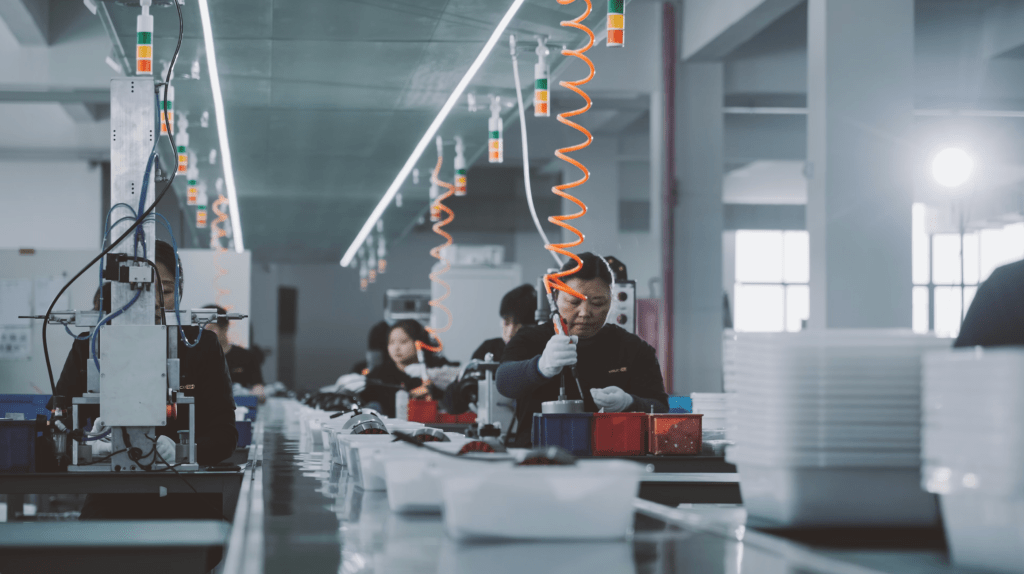
China’s economy, after dominating global manufacturing for almost three decades, is beginning to mature away from low-cost manufacturing in favour of innovation and high-value sectors. This, combined with higher labour costs and geopolitics, has increasingly pushed mass manufacturers—foreign and Chinese—toward Southeast Asia as an industrial hub. While presenting immense benefits, this influx of investment runs risks that need to be addressed for Southeast Asia to best capitalize on this opportunity.
The long 19th century was characterised by many occurrences: war, colonialism, economic development, and the cementing of the West as the centre of the world. But for that world, its economic heart beat in Britain. The birthplace of industrialization, Britain’s geopolitical position, combined with its immense empire, allowed it to emerge as the world’s foremost manufacturer, with the United Kingdom responsible for upwards of a quarter of total world trade in 1870 and 43% of global manufacturing exports in the 1880s. Benjamin Disraeli summed it up by calling Britain the “Workshop of the World.”
Everything came crashing down after the two world wars. In its aftermath, the US emerged as the new workshop of the world, accounting for half of all global industrial output by the end of the Second World War. But as free trade and high labour costs matured the US economy past manufacturing, the world’s top manufacturer shifted to the East, where a modernised China, with its low costs and huge population, took its place in 2010.
But 16 years on, it may be time for another hand-off. Structural dynamics have pushed labour costs for Chinese production higher and higher, while China’s economy is beginning to mature away from low-cost manufacturing and towards high-tech innovation, spurred on by unstable geopolitics. But if the workshop of the world is moving on, where has the manufacturing gone? The answer: low-cost, resource-rich, and western-friendly Southeast Asia. And if the region wants to best capitalize on this opportunity, it has some work to do.
Moving on from the China Model
For decades since the Reform Era, the “China Model” of export-led development emphasised leveraging its large population and state-led investment to develop low-cost manufacturing and attract investors. And that model brought spectacular success: foreign firms outsourced significant amounts of their production to China, with inward FDI growing from $3.5 billion USD in 1990 to $243.7 billion by 2005. In 2023, China accounted for 29% of the world’s total manufacturing output, exceeding the next three manufacturers combined. But despite being by far the world’s largest manufacturer, manufacturing’s place in China’s economy has steadily been shrinking, with the World Bank reporting that manufacturing has fallen from 34% of China’s GDP in 2004 to 25% by 2024.
Part of the reason is situational. A post-COVID slump in consumer spending, combined with recent geopolitical turmoil, has plagued industrial profits, resulting in a decline in manufacturing. But the other is structural, with two interrelated forces at play: industrial reorientation and labour market shifts. China’s focus has been moving away from low-cost export manufacturing and toward innovation and high-productivity industries. That shift was epitomised by the “Made in China 2025” plan developed by China in 2015, which emphasised innovation, quality-over-quantity, and green manufacturing. The results are two-fold. The first is that traditional low-cost manufacturing is being less prioritised by the state in favour of high-innovation sectors, such as AI, electric vehicles, and solar. The other is a priority placed on specialised and educated manufacturing workers. The newfound demand for this group, however, contends with a relatively short labour supply and declining population, driving up labour costs as firms compete over workers. And the numbers show: the average manufacturing wage of $0.30 USD/hr has soared to $7.00 USD/hr by 2025. That developmental shift is being sped up by geopolitics, as frequent trade conflicts with the US and Europe increasingly push firms away from China. Foreign firms have increasingly adopted the “China Plus One” strategy, seeking to diversify supply chains beyond China to avoid geopolitical uncertainty.
The net effect is that China’s traditional advantage as the world’s safe and low-cost hub for high-quantity manufacturing has dulled over time, with investors responding in kind. McKinsey, a consultancy, has reported that in their surveys that 38% of firms plan to reduce their supply chain presence in China. Manufacturing FDI into China has also declined by 17% from 2019 to 2023. Domestic firms have also been in a frenzy due to this shift. Chinese outbound manufacturing FDI has exploded in recent years, more than tripling from 2022 to 2023, as Chinese firms invest abroad rather than at home. Perhaps in recognition of that trend, China has made it an official goal to shift away from the Chinese export model of growth, with Premier Li Qiang instead exhorting officials to make “domestic [consumer] demand the main engine and anchor of economic growth.” Though mainly focused on tackling pessimistic consumer spending, the comment echoes a deeper fear of whether export-based manufacturing can keep the Chinese economy growing.
Where has the Manufacturing Gone?
Of all the destinations that China-anxious manufacturers have gone to, the largest share has gone to Southeast Asia. Boasting lower labour costs, rich natural resources, and broadly Western-friendly governments, manufacturing FDI has flowed steadily into the region throughout the 2020s.
Surprisingly, the vast majority of the newfound capital comes from Chinese firms. Of the roughly $76 billion USD of outbound manufacturing FDI from China in 2023, around a third goes to Southeast Asia. That amount comprised a third of ASEAN’s total manufacturing FDI in 2023, significantly surpassing its next competitors. And it shows. The Rhodium Group, a think-tank, reported that Indonesia was the largest recipient of Chinese renewable energy investment from 2022-2024, expanding its foreign-owned solar manufacturing capacity from only one gigawatt in 2022 to over 20 gigawatts in 2025. Crucially, Southeast Asia’s geopolitical position between East and West gives it leverage to play both sides. A key motivator for Chinese investment has been to complete its manufacturing process for goods in Southeast Asia to avoid China-specific tariffs. This, combined with general China-anxiety, has led Southeast Asian trade with the US—despite its tariffs—to surge 28% from September 2024 to 2025.
That position presents ASEAN countries with a prime opportunity to leverage both their geopolitical position and China’s economic transition, allowing them to both accumulate investment from abroad while simultaneously cementing their crucial role in international supply chains. And in a relatively short time, that position has reaped fruit: Southeast Asian R&D (measured by patent applications) has increased, ASEAN countries—such as Cambodia, Malaysia, and Vietnam—have seen an increase in industrial output and employment, and the process has brought high-value industries, such as EVs, semiconductors, and solar panels, to the region.
But it comes at a risk. The ISEAS–Yusof Ishak Institute, a research institute, cautions that the effects of this new manufacturing influx have been mixed, warning of three dangers. Firstly, high-value manufacturing processes have been slow to integrate, with Southeast Asian countries adopting more low-value manufacturing in the global supply chain. The positive benefits have also been spread unequally across SEA, with some countries, such as Vietnam, benefiting more in productivity gains and value added compared to other ASEAN countries. Thailand, for example, has seen net declines in industrial employment and output despite (or perhaps due to) the influx of foreign investment. This is likely due to the third danger, which is that the benefits from foreign investment have not significantly spilt over to domestic firms. Not only are foreign firms undercutting domestic firms in pricing, but they also create vulnerabilities in the economy to foreign shocks, as sectors become increasingly tethered to overseas firms. Malaysia, for example, faced a disproportionate shock to its semiconductor industries due to US tariffs, as foreign firms halted Malaysian projects.
Forging the Workshops of Asia
For Southeast Asia to best capitalize on its unique position, it must therefore seek to accommodate greater high-value manufacturing processes, enhance domestic competitiveness, and insulate against foreign shocks. Towards these, there are several policy areas Southeast Asian countries must focus on.
The first is the development of infrastructure. Eurogroup Consulting, a consultancy, suggests that Southeast Asia faces an infrastructure gap of around $102 billion in 2024. But with the greater flows of FDI into Southeast Asia, that gap must be filled to both encourage investors and handle the new economic activity. Modernising ports, roads, rail, warehouse capacity, and other logistical elements is crucial. But digital infrastructure, such as blockchain and data centres, will be essential as well, especially if SEA wishes to capture greater volumes of high-value manufacturing. The numbers, however, are going the wrong way. In 2024, international finance for infrastructure in ASEAN dropped by 50%, far greater than the 26% global average. National governments should move to fill the gap, while continuing to woo foreign capital on essential infrastructure projects.
ASEAN countries must also work on investing in education to develop greater human capital, as it will be crucial to attract high-value industries and innovative production. ASEAN’s most recent Work Plan on Education included measures to expand technical and vocational training, develop joint-certification, and extend educational access to education, which are all steps in the right direction. But there must also be a greater focus on efforts to expand education to build knowledge for FDI-heavy sectors: early STEM education, targeted vocational training, and greater emphasis on work-specific skills should be expanded on to both to accommodate high-value sectors, such as semiconductors and EVs, and enhance manufacturing productivity.
Expanding partnerships with other countries is also a must, both to cushion external shocks and provide greater sources of investment and trade. ASEAN has trade deals with seven other countries, including China and India, but greater steps should be taken, especially as Southeast Asia can capitalize on being a partner of both East and West. Promoting an image of geopolitical, monetary, and regulatory stability is a start, given investor fears over recent spikes of policy uncertainty in China and the world. This collaboration must also expand within ASEAN as well, with greater discussions on joint strategies to tackle mutual issues, such as infrastructure funding.
To ensure their competitiveness and cushion against external shocks, SEA governments must also work to uplift domestic firms against the new influx of foreign competitors. In response to its own foreign investment inflow, Malaysia has been experimenting with foreign-domestic cooperation measures—such as knowledge-sharing, technology transfer, and research collaboration programs—and a varying range of investment funds and grants for domestic firms. These measures must be expanded across ASEAN to ensure foreign investment creates meaningful spillovers for domestic firms, rather than undercutting them. It also allows governments to encourage desired behaviours, such as digital transformation or greater R&D investment.
Make no mistake. China does (and will continue) to represent the lion’s share of Asian manufacturing exports, with China almost doubling ASEAN’s total exports. However, this moment presents the world with a glimpse into a world where China’s mantle of “Workshop of the World” passes on. Yet, this time it won’t be to another country, like it has been before, but instead to a diverse region well-poised to take advantage of it. And in a world increasingly defined by diplomatic multipolarity, perhaps economically it will be too.
Image credits: Photo by TruckRun on Unsplash
Jackie Wang
Jackie Wang is a Toronto-based writer, studying Economics and Public Policy at the University of Toronto. Born in China, Wang has a particular interest in East Asian economic, cultural, and political affairs, with a focus on international trade. Outside of writing, Wang enjoys hiking, reading, and board games.
 Sino-Southeast Initiative