
Timor-Leste’s entry into ASEAN exposes a structural weakness in the region’s energy integration. The ASEAN Power Grid promises resilience through connectivity but remains vulnerable if new and weaker members stay outside its core infrastructure. With Timor-Leste reliant on costly diesel and lacking interconnections, external support is unavoidable. China’s deep experience in regional transmission and financing positions it as a potential enabler, if engagement is carefully aligned with ASEAN’s long-term integration goals.
“Bersatu kita teguh, bercerai kita roboh”
United we stand, divided we fall
— Malay proverb
When the first great reservoirs of Angkor in Southeast Asia were built more than a thousand years ago, they were conceived as an answer to a recurring threat. Monsoons arrived with destructive force and turned abundance into scarcity within months. King Indravarman I ordered the creation of the East Baray, a reservoir so large it reshaped the surrounding landscape and linked it to canals and embankments that redirected seasonal rainfall across the territory. That decision marked the birth of the Angkor hydraulic system and, for centuries, this system sustained one of the largest urban ecosystems of the premodern world. By the 14th century, local breakdowns spread, and water no longer moved evenly across the landscape. The same connectivity that had once distributed stability transmitted stress across the entire network. Angkor declined, and ultimately failed, because its system lost integration under pressure.
That history is relevant because ASEAN is now undertaking a comparable effort to construct a region-wide system driven by integration efforts. The ASEAN Power Grid is intended to link national electricity networks into a shared infrastructure that enables power to flow across borders in response to supply and demand shocks. Timor-Leste, ASEAN’s newest member, currently sits outside of this emerging framework. The effectiveness of the ASEAN Power Grid depends on the inclusion of all member states within the system. As with Angkor, uneven integration could affect the resilience of the regional system as a whole.
ASEAN’s Power Grid Vision and Recent Developments
The ASEAN Power Grid (APG) is a flagship regional initiative first raised in 1997 to connect the electricity networks of Southeast Asia. After years of progress, the project has gained new momentum as ASEAN leaders seek to address a volatile global energy landscape. In early 2025, ASEAN heads of state formally adopted an updated plan to accelerate power grid integration. The revised roadmap sets a target of achieving full regional interconnectivity by 2045 and identifies 18 priority interconnection projects, comprising a combination of overland transmission lines and sub-marine power cables, to facilitate multilateral electricity trade.
The renewed emphasis reflects structural pressures in Southeast Asia’s energy system. Regional electricity demand is projected to increase by approximately 60% between 2019 and 2040, driven by sustained economic growth and industrial expansion. At the same time energy resources are unevenly distributed across the region, with hydropower being more concentrated in the Mekong basin while solar and wind are strongest in Vietnam and Indonesia. In the absence of sufficient grid integration, cross-border electricity exchanges have remained largely bilateral and limited in scale, accounting for only around 3.6% of total regional power consumption in recent years.
Recent projects show that tangible progress has been made. In May 2025, Singapore’s government-linked energy company signed a memorandum of understanding with an energy consortium to develop a submarine interconnector from Indonesia, enabling the import of up to one gigawatt of solar power by 2029. During the same period, energy companies from Vietnam, Malaysia and Singapore agreed to explore new transmission infrastructure to export Vietnamese solar and wind power to neighbouring markets. Additional progress has also emerged from mainland Southeast Asia. In July 2025, a 600-megawatt wind farm in southern Laos began exporting electricity to Vietnam under the Monsoon Wind project, involving investments of upwards of $950 million USD.
Multilateral development banks have moved to anchor the ASEAN Power Grid in concrete capital commitments. In the same year, the Asian Development Bank and the World Bank Group jointly launched the ASEAN Power Grid Financing Initiative. As part of this effort, the Asian Development Bank and the World Bank committed an initial $10 billion for Southeast Asian grid investments linked to the ASEAN Power Grid alongside related clean energy projects. According to estimates from the ASEAN Development Bank, at least $100 billion in investment will be required by 2045 for transmission infrastructure alone to achieve complete regional interconnection across ASEAN member states. Other assessments place the total investment requirement considerably higher. ASEAN secretary-general, Dr Kao Kim Hourn, estimated that achieving the ASEAN Power Grid in full could require up to $764 billion when transmission, generation and system upgrades are factored in.
Timor-Leste’s Energy Challenges in an Integrated ASEAN Power Grid
The scale of financing required for the ASEAN Power Grid highlights a broader structural issue. Even if capital is mobilised and priority interconnections are delivered, the effectiveness of a regional grid depends on the ability of all member states to connect meaningfully to it. This is precisely where ASEAN’s newest member, Timor-Leste, is most vulnerable, as it remains entirely unconnected to any regional power network and continues to operate an isolated and fragile electricity system. Much of the country’s infrastructure was destroyed during the period of Indonesian occupation from 1975 to 1999. As recently as 2015, only about 60% of the population had access to electricity. A rapid donor-supported electrification push over the past decade has since raised household access to nearly 100% by 2021. Timor-Leste’s electricity system functions as an islanded grid with no cross-border interconnections, meaning the system lacks redundancy and cannot draw on an external supply during outages. Nearly all electricity generation in Timor-Leste comes from oil-fired power. The system requires continuous fuel imports, creating a structural foreign trade vulnerability by tying electricity security to external supply chains, exchange-rate exposure, and volatile global oil markets.
Timor-Leste’s leadership recognises that the current energy model is unsustainable. The state-owned Electricidade de Timor-Leste has pushed for plans to convert existing diesel plants to gas and to increase renewable energy to 50% of generation by 2030. Progress, however, has been slow: as of 2022, almost all electricity generation still came from oil fuels. Financial constraints are the primary barrier. Large-scale energy projects require significant upfront investment, and Timor-Leste lacks the capital to proceed independentlyl: a report from the International Monetary Fund warned that further withdrawals from its state petroleum fund from Timor-Leste’s state petroleum fund would lead to its full depletion by the 2030s.
At the ASEAN Ministers on Energy meeting in 2025, ASEAN energy ministers stressed the need to support Timor-Leste’s integration into ASEAN’s energy-related legal and technical arrangements. Interconnection remains the most critical gap, and its development would require significant concessional financing given Timor-Leste’s fiscal constraints. Realising Timor-Leste’s integration will need broader external involvement to bridge the divide on the country’s transition prospects.
Opportunities for Sino-Southeast Asian Energy Cooperation
China has existing exposure in Southeast Asia’s power sector. Chinese technical institutions have invested heavily—upwards of $2.7 billion USD—in regional infrastructure, becoming Southeast Asia’s largest energy patron. For ASEAN, the question is no longer whether China is present in the region’s energy landscape, but whether that presence can be aligned with ASEAN’s APG priorities, which include the integration of Timor-Leste.
Increased Chinese involvement, however, will not arrive without political friction, as Chinese involvement rarely stays confined to technical cooperation. Once financing begins to translate into equity positions or operational influence, domestic debates quickly shift toward sovereignty and control of critical infrastructure. The concern is not simply whether interconnections can be delivered, but whether strategic assets remain firmly within national hands. The Philippines offers a clear illustration. The State Grid Corporation of China, as an example, holds a 40% equity stake in the National Grid Corporation of the Philippines, giving China a direct minority position in a critical piece of Philippine transmission infrastructure. China’s stake in the national transmission operator has drawn scrutiny from local legislators and security agencies, with many criticising the foreign ownership due to national security concerns. The challenge, in this area of cooperation, would be to navigate how best to manage the need for tempered multilateral financing while simultaneously remaining grounded in ASEAN’s regional interests.
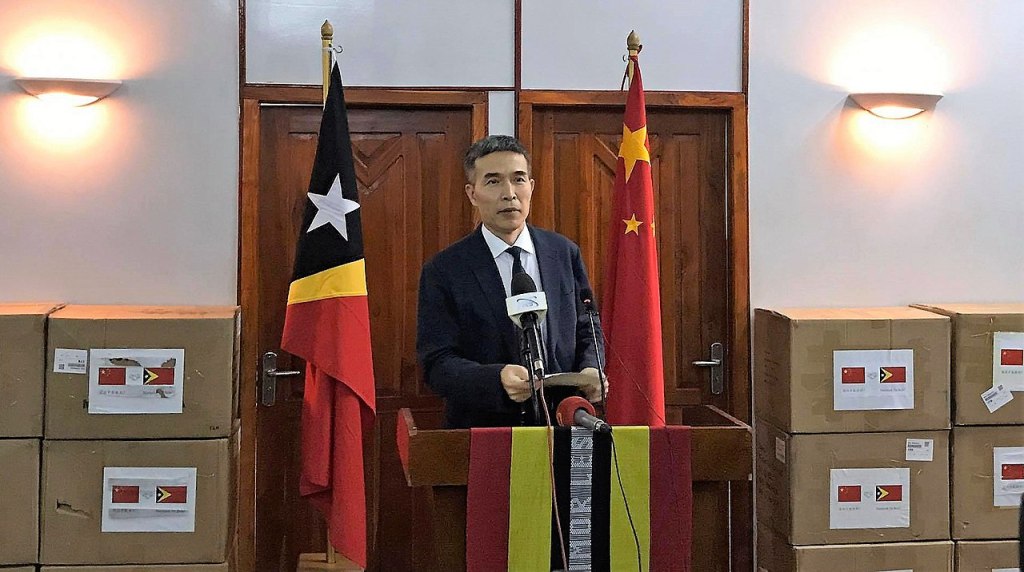
For China, the incentives are straightforward. The APG expands market opportunities for grid enterprises and aligns with the Belt and Road emphasis on hard connectivity. And Timor-Leste presents a concentrated opportunity with significant commercial interests at play. It could also mean more demand for Chinese grid and transmission technologies facilitated by economic trade. China’s existing foothold in Timor-Leste’s through prior energy support means that it has the familiarity needed to navigate Timor-Leste’s energy capacity building. In 2021, for example, China’s National Petroleum Corporation delivered 13,800 tonnes of diesel to the Betano plant under a supply arrangement with Timor-Leste’s national oil company, TimorGAP.
Moreover, involving China in such a multilateral regional arrangement can supplement collaboration in other critical areas such as rail connectivity infrastructure under the envisioned ASEAN-China Comprehensive Strategic Partnership and thus push for much broader, deepened economic cooperation. Access to additional capital via China’s state instruments can help with skyrocketing energy infrastructure costs, defraying the region’s financial burdens. Beijing’s recent power-move which saw its financial mechanism, the Multilateral Cooperation Center for Development Finance, approve a grant of $2.59 million in 2025 to improve ASEAN’s connectivity infrastructure is one such example. If ASEAN member states, Timor-Leste, and China coordinate effectively, the ASEAN Power Grid can strengthen energy infrastructure and stay true to its promise of an integrated Timor-Leste, not only in principle but in practice and. Uncertainty left unresolved has a way of reviving old failures, and in Southeast Asia, the memory of Angkor is never far away.
Image credits: Wikimedia
Pravin Periasamy
Pravin Periasamy is a Malaysia-based philosopher and director at the Malaysian Philosophy Society. He has authored over 100 articles on politics, economics, and philosophy in Malaysian national editorials such as The Star, Business Today, and Malaysiakini. Periasamy was named among Wiki Impact’s Top 100 Changemakers for his contributions to social justice in Malaysia. He is a graduate in Business from Sunway University.
 Sino-Southeast Initiative
