
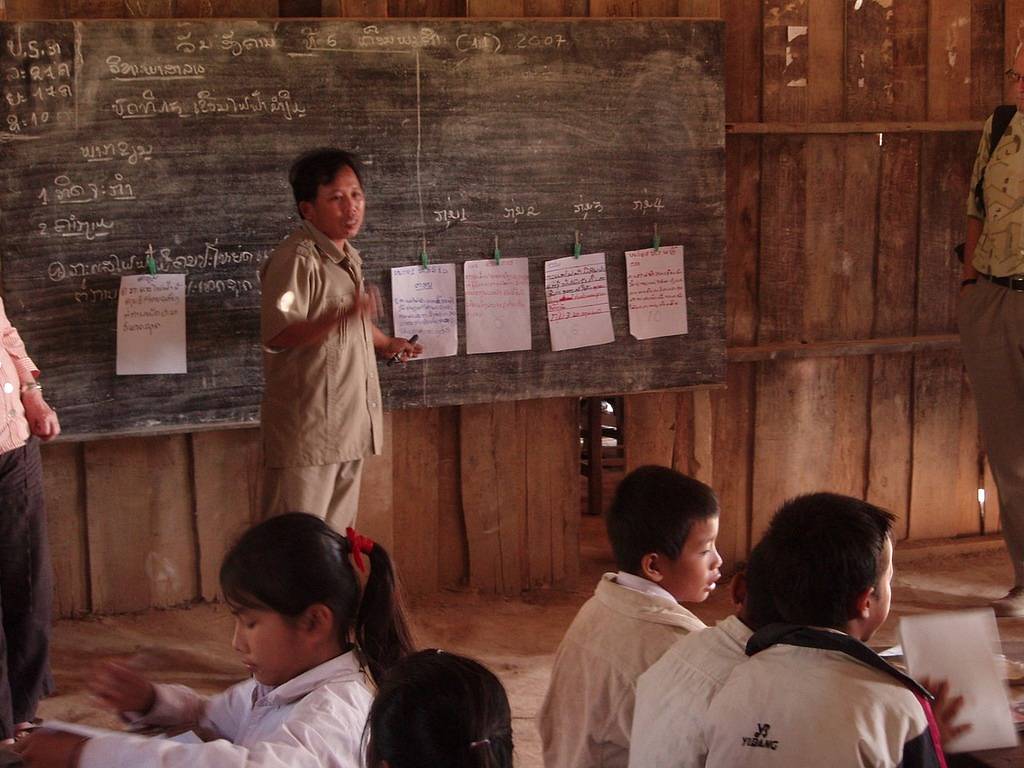
While Laos has made progress in reducing poverty, a deeper problem remains hidden beneath the numbers. Today, poverty is no longer determined by where people live, but rather by whether children finish school. Education deprivation has become the bottleneck in solving Laos’s poverty issue, yet current developmental policies continue to prioritise debt-funded infrastructure over education investment, limiting long-term poverty reduction. Redirecting attention toward higher education spending, conditional cash transfers, and enforced compulsory schooling is necessary to break the poverty cycle and create lasting change.
The Laotian government and partners have just signed a $1.35 million USD agreement to support secondary and high school students in rural provinces, aiming to improve access to education and teaching quality. But while impressive, the policy is driven by a fundamental misunderstanding: poverty in Laos is not driven by a lack of schools, but by poor families’ inability to keep children in them. Despite repeated funding efforts, most children from poor households still fail to finish basic education, trapping them in low-productivity work and persistent poverty. And yet, attention keeps being placed in the wrong areas, with education-to-GDP spending falling for over a decade straight. But unless Laos wants to be stuck in a trap of poverty, it needs to put serious attention into the education problem.
Education Deprivation: The Greatest Contributing Factor to Poverty in Laos
Although poverty in Laos has significantly decreased, its structure has undergone fundamental changes. The poverty rate in Laos has decreased by 46.22 percentage points over the last two decades; however, more than 90% of this improvement comes from within-sectoral improvements, rather than an effective flow of workers to high-productivity sectors. But even for that last 10%, the World Bank suggests that the contribution of rural-to-urban migration to poverty reduction is limited, and most poor migrants remain poor in urban areas, even if cities are more productive on average. So, this suggests that spatial migration alone cannot break the poverty trap. Rather, the real constraint on individual upward mobility is the lack of education and skills that new migrants (and existing urban workers) face. As a result, the nature of poverty in Laos has shifted from “geographic” (mostly rural) poverty to “human capital” poverty.
Educational deprivation is the most important single factor in multidimensional poverty in Laos. The 2023 Multidimensional Poverty Index (MPI) suggested that the education dimension (or lack thereof) contributes to overall poverty by as much as 44.8% in Laos, significantly higher than the health and living standards dimension. This is especially problematic given that Laos’s inequality-adjusted education index, a measure of the quality and accessibility of education, stands at 0.332, the second lowest in Southeast Asia. That disparity in educational outcomes is systematically eroding the national human capital, representing a major obstacle to Laos’s economic development.
Curiously, the education problem in Laos is not that Lao are unable to access education: there is not much difference in educational accessibility between urban and rural areas, and children in most regions can access education in a short period of time. The real problem lies in the serious inadequacy of the education completion rate, with only 31% of all students in Laos having completed upper secondary school, implying that many Lao students choose not to go to school. So, the problem is less that children can’t go to school, but rather they don’t want to go.
This presents a severe problem, since the lack of education severely restricts the ability of workers to enter high-productivity sectors of the economy, suppressing incomes. But as low incomes—and the need for children to work—is the primary constraint for school-goers, this relationship causes a vicious cycle, worsened by an environment of high inflation and the dominance of the informal economy. The result is that Laos’s poverty distribution is extremely skewed by educational outcomes: 95% of the impoverished population in Laos is concentrated in those who have not completed lower secondary school education, while almost no one who has completed higher education is impoverished. Therefore, Laos must break this vicious cycle to achieve long-term poverty reduction.
Where has the Money Gone?
The current five-year plan (9th NSEDP) has failed to place education at the core of poverty reduction. Although NSEDP has identified education issues in previous years, it has not fully established a link between education, human capital, and poverty reduction in its policies. Rather, education is seen more as a social-welfare goal than as a poverty-reduction tool. At the same time, the planning presents a clear outcome-based approach that ignores the structural reasons why children from poor families are unable to enter or remain in school, resulting in a lack of policy coherence and sustainability.
Laos’ NSEDP has long focused its resources on large-scale infrastructure projects and relied on external debt financing, leading to a recent debt crisis and a sharp contraction of fiscal space. Since 2013, the proportion of education expenditure to GDP has continued to decline (1.2% in 2023), far below the average level (3.4% in 2023) of lower-middle-income countries, and has been highly dependent on external aid. This model weakens the operational capacity of the education system in the short term and amplifies institutional risks in the medium to long term.
How to improve the Lao Education Policy?
In tackling such an entrenched issue, the first step is the most obvious. The education expenditure of the Lao government should at least reach or exceed the average level of lower-middle-income countries to accelerate education development and help impoverished families lift themselves out of poverty through education.
Policies should also focus on ensuring that all children can participate in and complete basic education. Reducing the cost of family education is key, including alleviating living costs through conditional cash transfers (CCT), and increasing the opportunity cost of not sending students through making education compulsory. Only when the threshold for participation is systematically lowered can education truly play a role in poverty reduction.
As of 2025, Laos has not established any conditional cash transfer (CCT) programs that require education participation as a condition. The government can collaborate with international organisations to implement CCT, reduce household living expenses, and encourage poor families to send their children to school. The conditions are that the beneficiary families must ensure their children attend school regularly and improve educational outcomes, including literacy rates and education levels, through rigorous effectiveness evaluations.
Laos should also follow Malaysia’s example and force parents to send their children to school through legal means. Malaysia’s experience shows that poverty reduction does not rely on scattered projects, but on stable domestic financial investment, strict compulsory education laws, and clear policy positioning to systematically transform education into a poverty reduction tool. That direction has led to clear results: Malaysia has increased enrolment and completion rates through its compulsory education system. All parents should provide their children with primary and secondary education. If parents refuse to fulfil their obligations may face imprisonment or fines, increasing the opportunity cost of not sending children to school and thus encouraging parents to fulfil their responsibility of sending their children to school.
The Laotian government can also link compulsory education to existing administrative systems to minimise the need for a new bureaucracy to monitor school attendance, rural-level governance, and CCT implementation. The village authorities and schools have collected basic population and enrollment data, which can be used to verify compliance. Legal compulsion alone is weak without incentives. Therefore, fines and legal compulsion serve as a backstop to ensure attendance, but the primary driver of participation in a graduated system is to link financial support to school attendance, reducing resistance and making compliance economically viable for poor households.
Conclusion
To sum up, the key to poverty in Laos lies not in ‘insufficient growth’, but in the ‘failure of human capital accumulation’. Insufficient education is not only a result of poverty but also the main reason for its persistence. If education continues to be seen as a subsidiary policy rather than the core pivot of poverty reduction strategies, even if Laos achieves short-term growth, it will be difficult to achieve long-term and inclusive poverty reduction.
In advancing educational success, Laos’ goal should be to increase opportunities for students to participate in education. Policies should focus on reducing the cost of schooling and strengthening institutional safeguards. On the cost side, CCT can be expanded to alleviate the burden on families. On the institutional side, punishment for not attending school can be increased through laws to reduce opportunity costs.
It is always easy for a government to bask in the glory of its own achievements. And for Laos, its rapid progress towards eliminating poverty has given many success stories to brag about. But Laos’s developmental journey is about to enter its hardest stage, one characterised by slow, gradual, and not-so-flashy change. Yet if it succeeds, Laos unlocks the possibility of both economic progress and advancing the people’s welfare, and that’s a success story worth sharing.
Image credits: Photo from Picryl
Tee Jia Yang
Tee Jia Yang is an economics student at the University of Nottingham Malaysia with a strong interest in international economics, development economics, finance, and market research. He has gained hands-on experience in literature review, data analysis, budgeting, and financial planning through his role as a Research Assistant with the School of Economics at UNM and as a Finance Intern with Malacca Securities. He is passionate about analyzing market trends and economic issues and is currently preparing articles that will be published in local media outlets.
 Sino-Southeast Initiative