
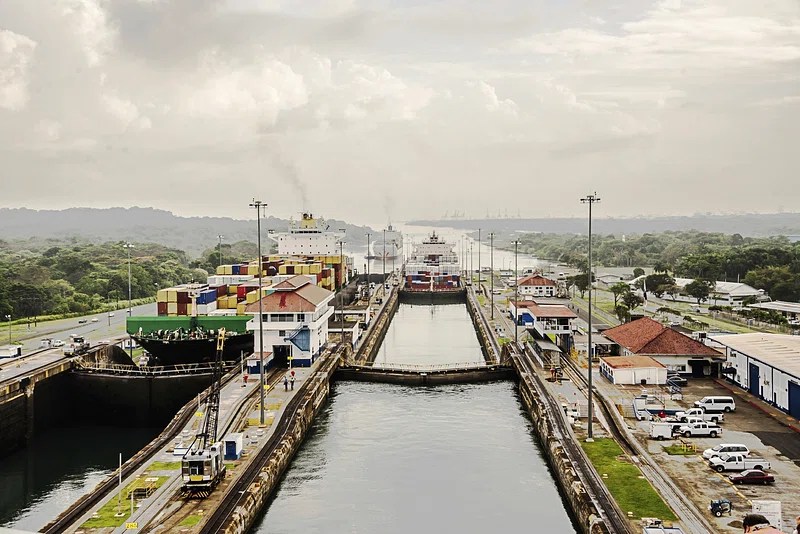
Every year, over 6% of global maritime freight, and 40% of US container traffic finds itself in a narrow Panamanian shipping waterway that splits the Americas into two. This small but ultimately essential shipping route – after a relative period of peace – finds itself in the center of messy global geopolitical affairs between two global superpowers and the small country that it is located in. The Panama Canal was largely built by American dollars, now operated by the Panamanian government, with major shipping ports on either side operated by a Hong-Kong based firm (among other firms). With growing Chinese political influence in the city-state, it appears that now the United States (and Panama) are taking issue.
The Panama Canal had always had a slightly complicated past. Built in 1881 by the United States government after multiple failed attempts by the French, the Americans have enjoyed near-total sovereign control over one of the world’s most important maritime chokepoints. Despite not being located in the US, tolls from the Canal were directly used as a revenue generating source for the US government. The Americans – which at the time (and arguably still so now) was the only global economic superpower in the Americas – disproportionately benefitted from the canal, as it disproportionately received a large share of goods transported from across the Pacific. The Canal also greatly helped reduce domestic trade costs within the US, as it drastically cut down shipping costs and shipping time from the East Coast to the West Coast and vice versa.
This arrangement – facilitated by the Hay-Bunau-Varilla Treaty, in which the Americans had total control of the Panama Canal, existed ‘in perpetuity’ for a large part of the first half of the 20th century. During the period, the Americans operated and managed the canal, and the manual labour work was mostly done by Panamanians. The issue of American ownership of the Panama Canal came to a head in 1964, when deadly riots broke out surrounding the issue of Panamanian flag-flying around the Canal. Locals viewed the canal as a colonial enclave, and growing pressure toward the US to secede the canal culminated in the 1997 Torrijos–Carter treaty, in which the US eventually passed full control of the Canal’s operations to Panama by 1999.
In the following years, Panama operated the canal’s governance on its own, but sold the canal’s port operations to a whole host of firms – from conglomerates, to shipping companies, and also state-owned firms. Since 1997, the year the rights to the canal were fully handed over from the US to Panama, the Panamanian government gave concessions to operations of its two largest ports – one on either side of the canal – to Hong-Kong based conglomerate, CK Hutchison. The Hong-Kong based conglomerate is owned – and up to 2018, ran – by Hong-Kong business magnate Li Ka-Shing, who historically has had political ties to Beijing. This has largely been a non-issue for the majority of time that CK Hutchison has held ports on the Canal. That is, until early 2026.
As part of the wider Donroe Doctrine – a recent addendum to the United States’ 5th president James Monroe’s 1823 Monroe Doctrine – Donald Trump has largely tried to establish wholesale American dominance in the western hemisphere. President Trump alleged in early 2025 that recent geopolitical tensions and growing CPP power is encroaching into Hong-Kong’s independence. He raised concerns that there is a concerning amount of Chinese state influence in the operations of private Hong Kong firms. Usually third-party countries opining on world affairs that they, in theory, are not involved in, would result in a nothingburger. However, the US’ influence on the Panama Canal (and indeed the rest of the world) cannot be understated.
Being in America’s backyard, Panama remains incredibly susceptible to US geopolitical and economic influence. 20% of Panama’s governmental income is tied to the ports, of which the US is its biggest customer. If Donald Trump was to follow through on his threats to take back the Panama Canal, the results could be catastrophic for the Central American country. The ‘taking back the Panama Canal’ rhetoric has largely been touted by the President in his Donroe Doctrine, along with threats of annexation of both Canada and Greenland, the renaming of the Gulf of Mexico to the Gulf of America, and the American capture of Venezuela’s President, Nicolas Maduro.
Following President Trump’s comments about CK Hutchison’s port ownership in the Canal, the Panamanian government acted swiftly. In late January 2026, the Panama Supreme Court struck down the law approving the concession of the two Panama Canal ports’ operations to CK Hutchison – citing audit and payment irregularities from an investigation back in July 2025 – which culminated in Panama seizing back the control of the ports from CK Hutchison. This decision was not taken lightly by CK Hutchison, Hong Kong, or China – as the former has launched an arbitration case against Panama regarding the decision to annul the concessions, and the latter two vehemently denying government influence in CK Hutchison’s operations on the Canal.
Panama’s decision to take CK Hutchison to court is quite puzzling upon initial inspection: the Hong Kong based company has run the two ports for well over two decades, and have concessions in place to run it for two more – why the sudden U-turn?
The Donroe Doctrine has been largely received as American resistance toward Chinese and Russian threats in the region, which have stemmed from a very long-standing trade war between the US and China, from when in his first term, President Trump put in place large tariffs and other trade barriers from Chinese goods. This ongoing rivalry between the US and China has now firmly set its sights on the Panama Canal’s operations, which puts the Panamanian government under massive stress to pick a side
All of this has also put CK Hutchison in a challenging position. In mid 2025, the Hong-Kong based conglomerate announced a deal to sell its two Panamanian ports, along with 41 other ports worldwide, to a consortium led by American firm BlackRock. However, this deal was met with significant backlash in Beijing, which had hoped for a sale to a fellow Chinese firm. With the impending arbitration case, the deal is now likely to be treading water, as the international rulings complicate the case.
The potential sale of the ports to BlackRock was viewed at the time as a win for President Trump in reducing Chinese influence in the Panama Canal, but the sudden seizure of the ports and the annulling of the concessions may be seen as a much larger win for the American President. While the process may be long and drawn out, a win at a geopolitical scale, and establishing an allyship with Panama may be more lucrative over the long run over pacing an American firm on the ports.
Panama’s alignment with the United States may reflect a strategic response to perceived geopolitical risks, as America now has been aggressively encroaching on global affairs and the domestic affairs of other countries. America has now established a strong precedent – look no further than Venezuela and Iran – that it believes that you should choose its side, or face the consequences. And it appears that Panama has heeded those warning signs.
Image credits: CC / OWP
Alexander Rafael Tjipta (Rafa)
Rafa, born and raised in Jakarta, Indonesia, is an undergraduate student at the University of Toronto studying Commerce and Economics. His interests lie in the field of industrial organization — currently writing his undergraduate thesis on this topic, as well as competition policy and antitrust. Rafa loves Chipotle, snowboarding, and the Vancouver Canucks.

