
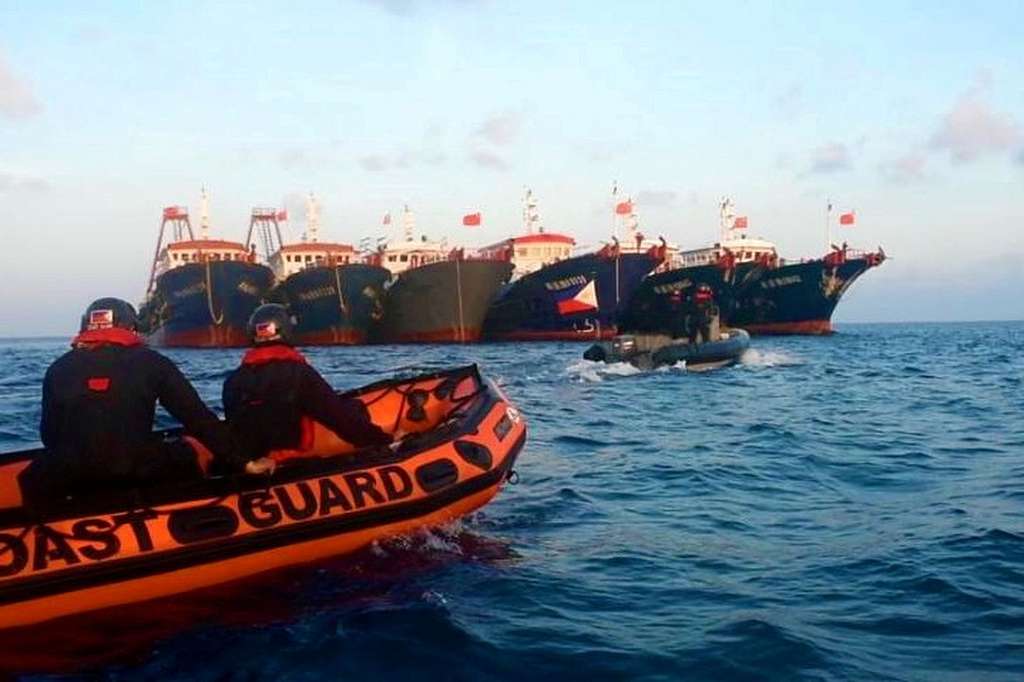
Behind the same nets aboard civilian fishing ships that cast 44% of the world’s fishing product hides a sophisticated web of legal facade serving as the foundation for China’s naval Gray Zone Warfare; one that justifies armed inspections and attacks on foreign fishing vessels, the disregard for international maritime safety laws to create shadow fleets undetected by global radar systems and the blatant invasions of Exclusive Economic Zones. This invisible initiative is what allowed the country, within a span of four months in 2020, to proudly report that it had expelled 1138 foreign fishing boats, detained 11 ships and arrested 66 foreign crew members. Without deploying a single naval fleet, China has established and situated paramilitary ocean militias and deterred rivalry in contested waters. This position was not achieved through overt force, but rather through the manipulation of law to forge a fishing industry that erodes the boundary between the civilian and the military.
With more than 57,000 industrial fishing vessels that account for 44% of the world’s visible fishing activity, China’s distant water fishing regime produces and trades more seafood than any other nation, and yet 74.9% of its catches are subsequently exported. This serves as a testament to their exponential economic expansion, but this agricultural sector at sea is not mobilizing alone. With such remarkable growth, the nation could afford to devote more resources to its maritime activities, which doubles as a means of national defence. Also known as the “vanguard” of the South China Sea, The People’s Armed Forces Maritime Militia (PAFMM) constitutes the largest and most highly organized maritime force in Asia. Operating as a hybrid civilian–military body, it draws on a vast fleet of up to 700,000 fishing vessels to escort commercial boats and assert de facto control over contested waters. However, overt displays of military power through these ‘vanguards’ are not the only means through which China flaunts its maritime prowess. Through the use of lawfare infrastructure, the country has successfully turned fishing into a translucent but nonetheless legitimate cover for Gray Zone Actions—coercive and threatening tactics that do not reach the threshold of war.
A Gray People’s War
A “People’s War” is a Maoist concept developed in the 1930s and 1940s, which originally described a strategy of protracted, land-based guerrilla warfare designed to wear down stronger adversaries over time. Today, this doctrine has been adapted to the maritime domain, where it underpins China’s approach to sustaining long-term sovereignty disputes in contested waters. To elaborate, a central element of a “People’s War” is endurance—absorbing attrition and sustaining pressure over the long term. Crucially, this does not require constant open combat. Instead, it often unfolds through gray zone actions that operate in the ambiguous space between routine peacetime activity and crisis. In this domain, China has adopted a legalistic approach—more precisely, a form of lawfare—to sustain a maritime “People’s War” through three key mechanisms.
First, in 2013, China integrated its law enforcement vessels into the China Coast Guard (CCG), making them responsible for maritime enforcement. Subsequently, in 2021, China passed the “Coast Guard Law,” which authorized the use of weapons when taking enforcement measures. According to Article 5 of the law, the scope of these measures include the supervision of marine resources. In other words, it allows CCG vessels to scrutinize foreign maritime fishing operations whilst armed. To illustrate, Chinese guard fleets are often adorned with reinforced hulls, ram bows, and some have even been sighted to have a fixed armament of machine guns. Additionally, in Article 18, maritime police agencies have the right to board and inspect these ships in “waters under the jurisdiction of China”. However, the phrase “waters under the jurisdiction of China” is not precisely defined, hence allowing the CCG to conduct operations in disputed waters such as the South China Sea. This is a point of tension, and hence serves as a testament to the weaponization of legal warfare for ‘gray’ conduct at sea. However, beyond being a legal deterrent, it also justifies cases where physical confrontation has occurred. For instance, in 2020, a Chinese vessel smashed a Vietnamese ship repeatedly in a display of aggression in the South China Sea to quash rivalry and stake control over this strategic waterway. Yet since the region falls under the umbrella of “water under the jurisdiction of China,” this skirmish was validated. Such tactics successfully dissuade the coast guards of other claimants from policing their own waters for fear of possible escalation with Beijing. However, beyond the use of law as a means to conduct such acts, it is also used to circumvent international regulations. This leads to the second way the war is being sustained.
To illustrate, in 2021, China also enacted the Personal Information Protection Law of the People’s Republic of China, which forbids the sharing of national or personal data to entities outside the country. As such, many fishing fleets at sea have turned off their Automatic Identification System (AIS)—a move called ‘going dark—and allow for unregulated activities such as the encroachment of Exclusive Economic Zones (EEZ) and the integration of militias into fishing fleets. This conduct is becoming a norm despite the AIS being a global standard for tracking and identifying ships at sea to ensure navigational safety and legal identification. These ‘ghost boats’ post 2021 make up for over 60% of the country’s ships, which allows the People’s Liberation Army Navy (PLAN) to coordinate with multiple domestic fishing fleets to harass other ships operating in international waters. To illustrate, between 2021 and 2023, Ecuador tracked around 510 Chinese fishing boats operating near the Galápagos EEZ, and in 2025 alone, the Philippine Coast Guard reported more than 50 Chinese maritime militia vessels operating in the Rozul Reef EEZ. Particularly in the case of the Philippines, the area has been a key point of interest for President Xi, who argues that it has been “Chinese territory since ancient times.” Furthermore, within the Philippine Archipelago, China has built military outposts on disputed islands and reefs as an additional buffer for its southern coastline that further entrenches and encircles Taiwan. Not being able to track these ships exacerbates the environment of impunity in the high seas, as a lack of transparency facilitates freedom for China to maneuver and commit such Gray Acts. This concern is exacerbated by the fact that China’s arsenal of advanced communications and electronics—including mounted radar and sonar—remains superior as rival nations such as the United States still lack the appropriate technology to detect this paramilitary force without AIS. The shortcomings of AIS, and the Chinese laws that now block its use, are prompting the US and its allies to find new measures to track maritime activity, and have even resorted to launching a competition to invent a new radar to detect ‘ghost boats’.
Beyond this invisibility, a third way China has sustained the ‘warfare’ is through a principle of distinction. To elaborate, while not formally a part of the People’s Liberation Army Navy (PLAN), the PAFMM is a network of vessels that organizes alongside fishing fleets to support them. Their strategic positioning abroad aims to assert territorial claims in the South China Sea without the use of direct military force, since the PAFMM is still, on paper, part of a general civilian fishing scheme. Yet it is this loose yet formal distinction between the civilian and the military that the China Maritime Studies Institute calls PAFMM “China’s Third Sea Force.” Through this narrative, vessels, despite officially serving as fishing boats, remain a tool for the state and the maritime militia; they not only operate under the direct support of the CCG and PLAN, but deckhands undergo formal paramilitary training and can be called to duty on demand. Additionally, the government requires on-board personnel to train alongside the PLAN and CCG, grants them social benefits as part of the “Spindrift Program” to provide vocational training for retired veterans, and then proceeds to employ them as fishermen. With one of the key pillars of international humanitarian law clarifying that civilians and civilian entities (such as shipping and fishing companies) must be distinct from military functions, China’s maritime militia risks blurring the line between fishing vessels and naval functions. Particularly as the aforementioned technological gap exists between China and its rivals, the maritime militia effectively serves as the “eyes and ears” of Chinese naval operations and intelligence activities, all while performing fishing duties. Positioned across areas of strategic interest, these fleets operate as a pervasive paramilitary maritime force for Beijing—readily deployed for surveillance, reconnaissance, and support of gray zone operations, all in service of advancing China’s territorial claims and broader maritime ambitions.
Conclusion: The Invisible Initiative
On a more granular level, China’s so-called dark fleets expose their crews to severe risks. Regular workers are often forced to carry out hazardous activities—such as at-sea transshipment—without adequate training, aboard vessels that lack basic sanitation and safety standards, and are sometimes left stranded at sea without sufficient food, communication, or fuel. While some are indeed seasoned paramilitary members, there is still a large majority of individuals who are simply recruited and exploited fishermen from rural areas who are unaware of the illegality of their boat.
Hence, this initiative is rendered both physically invisible—through the deliberate disabling of AIS tracking systems—and legally ambiguous under the cover of Chinese domestic law, exposing the stark limits of international response. The International Maritime Organization—the very body tasked with upholding maritime law and safety—has remained effectively paralyzed, as “member states don’t agree on how to respond.” To make matters worse, the Atlantic Council has also called out the EU states for looking the other way with the rise of shadow fleets across the globe. What emerges is a third way this regime of militia-fishing has been rendered invisible: a silence enabled and sustained by international inaction.
Image credits: Photo from Picryl.com
Erica Ruoxin Zhang
Erica Zhang is a 1st year Humanities student at the University of Toronto St. George with a membership to Woodsworth College from White Rock, British Columbia. She is currently Vice Director for UTMUN UNESCO, formally a writer for her high school newspaper, and has placed in essay competitions such as the John Locke Institute Essay Competition and the Royal Commonwealth Society Writing and Speaking Contest.
 Sino-Southeast Initiative